


Remuneration report

Remuneration Committee Chair
Maya Makanjee
Part 1 – Background Statement
Introduction
On behalf of the Board of directors and the Remuneration Committee, I am pleased to present the remuneration report ("the report") for 2021.
The Remuneration Committee aims to ensure that Datatec remunerates fairly, responsibly and transparently to promote the achievement of strategic objectives and positive outcomes in the short, medium and long term (King IV Principle 14). Our committee is focused on ensuring that the remuneration structures at Datatec drive value creation for our stakeholders, with a reward framework and value proposition for our executives which is in accordance with ethical corporate governance standards. We are satisfied that our policies are aligned with shareholder value creation but to ensure greater alignment going forward, we are proposing changes to the CEO's deferred incentives, effective FY23 (full details are disclosed below).
Covid-19 pandemic
The declaration of Covid-19 as a pandemic by the World Health Organization ("WHO") on 11 March 2020, at the start of the Group's new financial year, heralded an unprecedented global economic and humanitarian crisis. The Group's immediate response was to keep employees safe in accordance with government guidelines in all geographies of operation which typically involved maximising working from home, social distancing and all advised measures to limit the spread of Covid-19.
The Group's remuneration structures and the mechanisms in place as described in the previous remuneration report proved robust in maintaining the aims of the committee noted above during the pandemic. The committee faced up to the challenges of setting short-term incentive ("STI") and long-term incentive ("LTI") targets for FY21 at the start of the pandemic and did not make any adjustments to the plans in operation or intervene with the use of discretion.
Our performance and pay outcomes in FY21
All Datatec's divisions delivered a solid operational performance in FY21 with all divisions showing resilient trading with strong operating cash flows and significantly enhanced liquidity. This was achieved despite the challenging socioeconomic environment resulting from the declaration of Covid-19 as a pandemic by the WHO on 11 March 2020, at the start of FY21. The STI targets set for management by the committee at the height of the pandemic were overachieved.
A summary of the main remuneration outcomes follows with the detail set out in the policy and implementation sections of this report:
- Executives received no increases to guaranteed pay for FY21 due to Covid-19 uncertainty;
- Likewise, non-executive directors' ("NED") fees were not increased;
- STIs earned for FY21 increased compared to FY20 as a result of performance above expectations;
- Only 50% of the conditional share plan ("CSP") awards granted in May 2018 with a performance period that ended 31 March 2021 have vested, because the underlying earnings per share ("uEPS") performance condition for FY21 was achieved in full. The return on invested capital ("ROIC") performance condition for the other 50% was not met.
Performance and pay targets for FY22
The main remuneration targets and outlook is summarised below with the detail set out in the policy and implementation sections of this report:
- Executives have received a 5% increase in guaranteed pay for FY22 – the first increase since their base salaries were decreased on 1 March 2019;
- Likewise, NED fees are proposed to increase by 5% (subject to shareholder approval) – the first increase for three years;
- STI – the weighting between corporate and personal performance for FY22 is set at 75%/25% respectively. We introduced a new key performance indicator ("KPI") regarding the reduction of the structural discount currently applying to Datatec. This new KPI makes up 10% of the 25% personal element;
- LTI deferred bonus plan ("DBP") – as a result of our higher STI levels achieved in FY21, the deferral and co-investment by the company into the DBP was higher compared to previous years. LTI (CSP) awards were made in line with our policy.
Proposed changes to our policy
We do not propose any changes to our policy for FY22. However, we plan to replace the DBP with effect from FY23 with a new share-based payment scheme: it is proposed that the participants' FY22 STIs (to the extent that the mandatory deferral thresholds are reached) will no longer be deferred into the DBP, instead they will participate in a new deferral mechanism termed the deferred bonus warrant ("DBW") that we believe will more closely align their interests with those of shareholders and the strategic direction of Datatec. The participants will continue to defer a portion of their STIs into restricted shares, but the Company's co-investment component will be awarded as share appreciation rights instead of full value shares. This means the Company's co-investment component is fully at risk and aligned with shareholder appreciation over the long term, thereby ensuring a continuous performance under-pin via share price appreciation. In constructing the new DBW, Datatec was mindful that the DBW should not result in any shareholder dilution and as a consequence the DBW will only be capable of being settled with shares purchased on the market at the time of settlement. Overall, we view these as positive changes and believe they address some of the prior issues raised by shareholders in relation to the DBP.
Linking pay to our strategy
Datatec's strategy remains to improve shareholder returns over the medium term through a combination of corporate and business actions aimed at enhancing the competitiveness and profitability of our subsidiaries and operating divisions. The Group's remuneration policy seeks to align remuneration to the achievement of the Group's strategic objectives.
Aligning remuneration to our strategic objectives
| STRATEGIC OBJECTIVE | SHORT-TERM INCENTIVE (“STI”) | LONG-TERM INCENTIVE (“LTI”) | ||||||||
| Value generation | – | FY21: The performance condition for two-thirds of CSP vesting in 2023 is absolute total shareholder return ("TSR"); | ||||||||
| FY22 – personal KPI for the executive directors' STI: reduce structural discount | FY22: The performance condition for two-thirds of CSP vesting in 2024 is absolute TSR. Furthermore, executive share ownership requirements and the DBP's additional two-year holding period post vesting ensure shareholder alignment over the long term. | |||||||||
| – | FY23 – new STI deferral plan (DBW) is a further value generation alignment. | |||||||||
| Underlying earnings per share | FY21 target for 25% of STI was based on uEPS* | FY21: Performance condition for one-third of CSP vesting is uEPS growth over three years to FY23. | ||||||||
| FY22 target for 45% of STI is budget uEPS | FY22: Performance condition for one-third of CSP vesting is uEPS growth over three years to FY24. | |||||||||
| Earnings before interest, taxation, depreciation and amortisation ("EBITDA") | FY21 Target for 25% of STI was based on Group EBITDA* | – | ||||||||
| FY22 Target for 20% of STI is budget Group EBITDA | – | |||||||||
| Other quantitative measures addressing current short-term priorities | FY21 and FY22 metrics addressing Logicalis and Westcon International working capital. | – | ||||||||
| Covid-19 | FY21 metrics address crisis management and post Covid-19 strategy | – | ||||||||
| FY22 metric covering leadership post Covid-19 | – | |||||||||
| * | Note – the market conditions prevailing during the early stages of the Covid-19 pandemic in the early months of FY21 meant that it was extremely difficult to prepare an accurate FY21 budget at the time that the Remuneration Committee set the STI targets, so instead the Committee used a target and range for uEPS and EBITDA based on the prior year draft result which was considered a challenging target in the prevailing circumstances. |
The context in which the committee has set STI and LTI targets for FY22 flows from the strategic imperatives of the Group.
In recognition that the Group has moved into a strategic value creation and realisation phase of its development, the committee decided to replace the ROIC measure used previously in the CSP with absolute TSR in FY21, making up two-thirds of the weighting.
The committee believes the use of absolute TSR will align remuneration with value creation for shareholders and has continued to apply the same principle for FY22.
Motivating the drive to improve profitability remains of high importance for which the uEPS and EBITDA growth targets are key in the STI. The uEPS growth performance condition remains part of the LTI for FY22 via the CSP, constituting one-third of the weighting.
The Remuneration Committee is satisfied that the remuneration policy has achieved its objectives in FY21. We believe the policy and implementation set out in this report achieve an equitable alignment of shareholder and management interests.
Remuneration Committee constitution and operation
The role of the committee is to assist the Board in ensuring that the Company remunerates directors and executives fairly and responsibly in alignment with the creation of long-term shareholder value and to ensure that the disclosure of director and senior management remuneration is accurate, complete and transparent. The Remuneration Committee operates under terms defined in its charter, which has been approved by the Board.
The Remuneration Committee charter is available on the Group’s website www.datatec.com.
The Remuneration Committee comprises the following independent non-executive directors:
- Maya Makanjee (Chair)
- Johnson Njeke
- Ekta Singh-Bushell
Stephen Davidson and John McCartney stood down from the committee on 31 May 2020 and Ekta Singh-Bushell joined the committee on that date.
The Remuneration Committee's meetings during FY21 and to the date of this report (together with the attendance of the committee members), are shown in the table below:
| 19 March 2020 |
19 May 2020 |
16 July 2020 |
19 October 2020 |
21 January 2021 |
10 March 2021 |
18 May 2021 |
|||
| M Makanjee | P | P | P | P | P | P | P | ||
|---|---|---|---|---|---|---|---|---|---|
| MJN Njeke | P | P | P | P | P | P | P | ||
| E Singh-Bushell | P | P | P | P | P | ||||
| JF McCartney | P | P | |||||||
| SJ Davidson | P | P |
| P = present | |
| = not a committee member | |
The CEO and CFO may be invited to attend portions of meetings of the Remuneration Committee, but neither may take part in any discussions regarding their own remuneration.
The Remuneration Committee employs the services of specialist consultants in the field of executive remuneration to provide advice. The consultants which have been retained in this role during FY21 and to date are PricewaterhouseCoopers and Vasdex Associates. The committee is satisfied that the consultants have provided independent and objective advice and, while giving due consideration to any advice received, has made its decisions independently in accordance with its charter.
The committee reviews its performance annually by means of questionnaires completed by individual committee members and attendees which are then discussed at Board and committee meetings. These appraisals enable the committee to evaluate its effectiveness objectively and to conclude whether it is meeting its objectives as described in its charter.
Future focus areas
The committee intends to continue the consultation process with shareholders and discuss the continuing evolution of the remuneration policy with an increasing focus on ESG. The committee will continue to focus its oversight on fair and responsible pay, diversity and inclusion and talent management throughout the Datatec Group.
Shareholder engagement
Over the past few years, the Remuneration Committee has undertaken a programme of shareholder consultation to ensure shareholders' views on remuneration were properly and accurately addressed by the committee and considered in the Group's remuneration policy and implementation practices. This consultation process is ongoing and I will be available, with Stephen Davidson, the Chair of the Board, after the publication of this report to discuss remuneration-related issues and other ESG matters ahead of the 2021 AGM.
At the AGM on 29 July 2021, you will be requested to endorse our remuneration policy and the implementation thereof. We will continue our engagements with shareholders to discuss areas of concern you may have; your constructive input is valued and appreciated as we continue to improve our remuneration framework. On behalf of the Remuneration Committee, I thank you for your continued support and feedback.
M Makanjee
Chair
Remuneration Committee
May 2021
Part 2 – Remuneration policy
The objectives of the Remuneration Policy are to:
Set remuneration levels to attract and retain the best local and international talent who will enhance business performance.
Recognise and reward superior performance when it occurs.
Direct employees’ energies and activities towards key business goals and strategic outcomes.
Align employees’ and shareholders’ interests.
To achieve this, Datatec rewards its executives and managers in a way that reflects market dynamics and the context in which it operates. Datatec is structured as a group which actively manages its two principal divisions, Logicalis and Westcon International. The Remuneration Policy applies throughout the Group but the details provided are applicable to the Datatec executives. All elements of the Remuneration Policy are aligned to the strategic goals of the Group. For purposes of this report, a high level overview of the remuneration elements and design principles informing remuneration arrangements for all employees is provided, with in-depth focus on Datatec executives.
Key principles of the Remuneration Policy are to:
Reward all employees suitably for their contribution to the Group’s operating and financial performance.
Apply fair and responsible pay principles to all employees across the Group.
Promote a common interest with shareholders.
Consider the international ICT industry, market and country benchmarks to ensure the Group’s remuneration is competitive in regions in which the Group operates, particularly the US, Brazil and the UK.
Make a significant proportion of the remuneration of executive directors and senior managers performance-based.
Balance the performance-based element of remuneration between the achievement of short-term and long-term objectives.
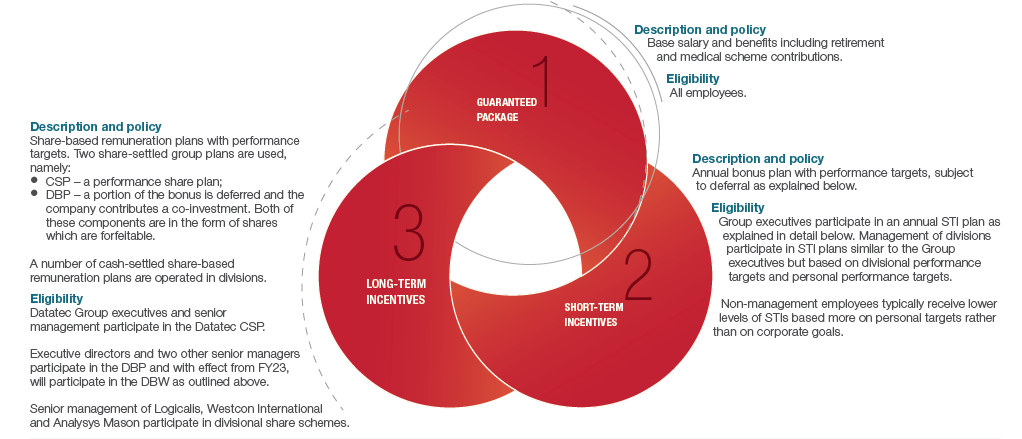
These principles are enshrined in the three main elements of remuneration:
Base salary
The base salary provides individuals with a fixed income and is subject to annual review by the Remuneration Committee. Executive directors and senior executives are entitled to employment benefits determined by the level of base salary including: defined contribution pension; medical insurance; and death and disability insurance. When executive roles change or new appointments are made, the committee makes use of external market data relating to comparable international ICT companies, including those based in the US and the UK, and benchmarking exercises are carried out by third-party advisers in determining appropriate levels of base salary.
Short-term incentive
Structural overview:
Bonus formula |
The STI is calculated in relation to base salary as follows: Base salary x on-target STI percentage x [(personal score x personal weighting) + (corporate score x corporate weighting)] |
|||||||||||||||
On-target STI percentage of base salary |
CEO: 175% Potential outcomes for the STI in relation to base salary are illustrated in the scenario analysis. |
|||||||||||||||
Weightings between corporate and personal performance measures |
The weighting between corporate and personal performance is reflective of the participants seniority and the following weightings apply:
|
|||||||||||||||
Target setting |
Each element of the bonus is based on the achievement of a target: if that target is reached the bonus element is described as "on-target". The Remuneration Committee establishes the target and a range around the target demarcated by "guard-rails" such that the bonus for each element is capped if the upper guard-rail is reached. Below the lower guard-rail, zero bonus is earned and at the lower guard-rail 40% of on-target bonus is earned. Between the guard-rails and the on-target position the bonus outcome is obtained by linear interpolation. The on-target bonus levels in relation to base salary are set out in the table below and remain unchanged from FY21. The maximum bonus achievable, referred to as the cap, is 143% of the on-target STI for the CEO and 153% of the on-target STI for the CFO. STI as a percentage of base salary
Potential outcomes for the STI in relation to base salary are illustrated in the scenario analysis . The metrics used and bonus outcomes for FY21 are shown in the implementation report. |
|||||||||||||||
Delivery of the STI (applicable to executive directors and senior Group executives) |
The STI is partly delivered in cash and partly delivered in shares. The portion of the STI that is deferred on a mandatory basis into the DBP depends on the extent to which targets have been met and comprises a minimum and maximum deferral percentage that is operated on a sliding scale:
|
|||||||||||||||
FY22 metrics:
The corporate financial goals constitute 75% of the total STI for FY22. These targets include underlying earnings per share and EBITDA as well as cash management/working capital targets which the committee introduced in the prior year as these were particularly critical under the Covid-19 environment. There are separate metrics for Logicalis and Westcon International as the two businesses have different working capital dynamics.
FY22 Bonus structure
| 1) Underlying earnings per share | US cents | Bonus | ||||
| Lower guard-rail | -13% | 40% | 45% |
|||
| On target | Budget | 100% | ||||
| Upper guard-rail | 13% | 160% | ||||
| 2) EBITDA | US$ million | Bonus | ||||
| Lower guard-rail | -13% | 40% | 20% |
|||
| On target | Budget | 100% | ||||
| Upper guard-rail | 13% | 160% | ||||
| 3a) Working capital – Logicalis net overdraft | US$ million | Bonus | ||||
| Lower guard-rail | 25% | 40% | 5% |
|||
| On target | Target | 100% | ||||
| Upper guard-rail | -25% | 160% | ||||
| 3b) Working capital – Westcon International net working capital days | Days | Bonus | ||||
| Lower guard-rail | 10% | 40% | 5% |
|||
| On target | Target | 100% | ||||
| Upper guard-rail | -10% | 160% | ||||
| 4) Personal KPIs – CEO and CFO | Bonus | |||||
| ESG | 10% | 25% |
||||
| Leadership (operational and organisational) | 5% | |||||
| Reduce structural discount | 10% | |||||
| Total on-target bonus | 100% |
* Adjusted means excluding all restructuring costs.
The FY22 targets for uEPS, EBITDA and working capital metrics based on budget are not shown as this is commercially sensitive information but will be fully disclosed next year in the implementation section of the FY22 remuneration report.
The personal KPIs agreed by the committee for the executive directors for FY22 are as follows:
- ESG – corporate citizenship and governance evolution;
- Leadership – development of the Group's operational and organisational strategy for the "new normal" post the pandemic;
- Reduce structural discount – initiatives to achieve value realisation.
Long-term incentives
Group plans – structural overview:
| DEFERRED BONUS PLAN (UP TO FY22) | DEFERRED BONUS PLAN WITH WARRANTS (FROM FY23) | CONDITIONAL SHARE PLAN | ||||||||||||
Instrument |
The deferred STI (deferred shares) and the Company co-investment shares are awarded as restricted shares with voting and dividend rights. |
The deferred STI is in the form of shares and the Company co-investment is awarded as share appreciation rights ("SARs"). The SARs will be awarded at market value using the same price applicable to purchase the deferred shares. No dividends will accrue on the SARs during the exercise period. |
Conditional rights to shares subject to performance vesting conditions. |
|||||||||||
Eligibility |
Executive directors (CEO and CFO) and two senior Group executives, provided the minimum STI levels are achieved as indicated above.
|
Executive directors and Group executives and staff. | ||||||||||||
Allocation levels |
The minimum participation level for executives in the DBP is on a sliding scale with a 20% mandatory investment between 50% of target and on-target bonus and 33% for above on-target bonus. The maximum proportion of annual bonus which participants may defer into the DBP is 75%. |
The minimum participation level in the DBW will be on a sliding scale with a 20% mandatory investment between 50% of target and on-target bonus and 33% for above on-target bonus. The maximum proportion of annual bonus which participants may defer into the DBW will be 75%. The number of SARs to be awarded will be based on an actuarial valuation. |
The quantum of awards is based on annual base salary and the face value of awards which is the current Datatec share price (using a 30-day volume-weighted average price) as follows:
The number of awards granted to participants who also participate in the Westcon International Equity Appreciation Plan ("EAP") is scaled down to avoid "double dipping" as explained below. |
|||||||||||
Vesting period |
3 years. |
|||||||||||||
Additional holding period |
For the STI and co-investment share elements, a holding period of two additional years follows the vesting period of three years. |
A holding period of two additional years will follow the vesting period of three years for the share element. The SARs are subject to a 4-year exercise period commencing on the vesting date and will be subject to a 2-year holding period post vesting. |
||||||||||||
Performance period |
1 year, aligned with the STI performance as explained above.
|
3 years. | ||||||||||||
Performance conditions |
No prospective performance conditions apply, but performance is an entry qualification requirement. |
No prospective performance conditions apply, but performance is an entry qualification requirement. Further performance alignment via share price appreciation before the SARs will be exercisable. |
Performance conditions apply to the grants and the conditional awards are held for a performance period of three years. At the end of the three-year performance period the performance conditions are tested and if met, awards vest on a sliding scale between 50% at threshold and 100% at the upper target. |
|||||||||||
Plan and individual limits |
The maximum number of co-investment shares which can be delivered to any individual participant in the DBP is 1.6 million shares. The maximum number of new shares which can be issued to participants to settle obligations under the DBP is 3.2 million shares. |
The new DBW will be non-dilutive to shareholders as it will be settled by purchasing shares in the market. |
The maximum number of shares which can be delivered to any individual participant in the CSP is 3.7 million shares. The maximum number of new shares which can be issued to participants to settle obligations under the CSP is 7.4 million shares. |
|||||||||||
Termination of employment provisions |
If an executive director resigns from the Company or is terminated for fault e.g. dismissal on grounds of misconduct, proven poor performance, dishonest or fraudulent conduct ("bad leaver") all unvested and unexercised LTI awards are forfeited. This includes shares in the DBP (both the employee's deferred STI element and the co-investment from the Company) within the three-year vesting period (DBP) or while the SARs remain unexercised (DBW). In addition, such executives will be required to repay all dividends (pre-tax value) earned from the award date under the DBP (bonus shares and deferred shares) and DBW (bonus shares). If termination is at the Company's instigation and not for fault ("good leaver"), the executive will retain a portion of LTI share incentive awards which have been granted but not yet vested. The proportion will be determined pro rata, relative to the time of the vesting period which has elapsed up to the termination date and will in the case of the CSP, be adjusted based on the extent to which performance conditions have been met. The terminated executive will continue to hold the reduced amount of awards until the vesting date when they will vest along with the other grants in accordance with the rules of the scheme if the relevant performance conditions are satisfied. |
|||||||||||||
CSP Performance conditions for FY22:
The committee intends to apply the same performance conditions to the May 2021 (FY22) CSP grant; the following performance conditions and targets will apply:
| Condition | Weighting | Performance period | Threshold (50% vesting) | Maximum (100% vesting) | |
| Absolute TSR | Two-thirds | From the FY21 results announcement day being 25 May 2021 until the day of the FY24 results announcement approximately three years later. | 11.1% compound annual growth rate ("CAGR") | 13.1% CAGR | |
| uEPS Growth | One-third | 1 March 2021 to 28 February 2024. | US CPI Inflation +2% CAGR | US CPI Inflation +4% CAGR |
Linear vesting applies between threshold and target levels
Potential outcomes for LTI in relation to base salary are illustrated in the scenario analysis below.
Divisional long-term incentives
The Group's divisions operate the following share-based incentive schemes to incentivise management to generate value in the divisional entity:
- Westcon International EAP
- Logicalis and PromonLogicalis Latin America Limited ("PLLAL") CSP Schemes
- Logicalis and PLLAL SARs Schemes
- Westcon International SARs Scheme
- Analysys Mason Performance Share Scheme
- Other Share Schemes, applicable to start-up business in the Group
These schemes are cash-settled (with the exception of the Analysys Mason Performance Share Scheme which is partly settled in Analysys Mason shares) and are based on the divisional entity's valuation/notional share price. Datatec shares are not used in the settlement of the subsidiary share schemes.
All the divisional share-based remuneration schemes operating in the Group are accounted for under IFRS 2. Details of the operation of the subsidiary division share schemes, including grants, exercises and lapses during FY21 and the prior year, are included in Note 2 to the consolidated annual financial statements.
Further details on the divisional long-term incentives applicable to the Group executives are disclosed below.
Westcon International Equity Appreciation Plan
The Remuneration Committee implemented an EAP for Westcon International senior management to incentivise value generation. Participants have been awarded a once-off grant of "units", whose value will be linked to the value of Westcon International; this is a notional base value which was estimated to be US$125 million (the "hurdle"). The units will not have any share rights, in particular they will not have the right to dividends or votes.
10% of the value of Westcon International above the hurdle will be paid to the EAP Pool on a sale of Westcon International. Each unit will receive a pro rata share of the EAP Pool when Westcon International is sold.
For example, if Westcon International is sold for US$300 million, the EAP Pool will be US$17.5 million: ((US$300m – US$125m) x 10%). If there are 100 000 units in issue, each unit will be worth US$175.
During FY21, Datatec recapitalised Westcon International by converting US$80 million of inter-company loans to equity investment. This capitalisation will be adjusted for in computing the equity appreciation for participants at the end of the EAP.
If Westcon International is not sold within five years of the start of the scheme on 1 March 2018, the business will be valued by an independent valuer at 1 March 2023 and the EAP will pay out to participants on the basis of that valuation. Such a valuation will be undertaken using a methodology which is fair and reasonable to all stakeholders including Datatec shareholders and participants in the EAP taking account of the recapitalisation noted above.
The following arrangements are in place for the Datatec Group executives:
Because the executive directors of Datatec Group are also executives of Westcon International, they participate in the Westcon International EAP in addition to their participation in the Datatec CSP and DBP. The annual grant of Datatec CSP conditional shares for the Datatec executives who participate in the Westcon International EAP is reduced by an "equivalence" factor to avoid double participation in relation to reward opportunities.
In addition, for the Datatec executives who participate in the Westcon International EAP an adjustment of 10% carried interest (CAGR) will be added to the equity base of US$125 million. This annually increasing threshold will be used for the equivalence factor calculation above.
Further, the committee has capped the level of ultimate reward possible for the Datatec executives who participate in the Westcon International EAP.
Potential outcomes for the executive directors of Datatec Group under the Westcon International EAP illustrating the effect of the reduction in CSP grants are set out in the scenario analysis section below.
Datatec Group additional incentive
The CEO has an additional incentive in relation to Westcon International which will be earned if the business is sold for more than US$300 million. This additional incentive is equal to the cash value of 10 000 Westcon EAP awards with the same condition of 10% CAGR in the threshold as the other awards.
Discretion
The remuneration policy set out in this part 2 of the remuneration report sets out in detail the methodology, metrics and principles which will be used to determine the remuneration of Datatec directors and executives. It is not intended that there should be any departure from the policy in FY22. However, the Remuneration Committee notes that exceptional circumstances can arise, for example the Covid-19 pandemic and the global economic crisis still prevalent at the date of this report, which make it expedient for the committee to retain the ability to exercise discretion in responding to exceptional situations.
If the committee's exercising of discretion necessitates any departure from the policy, such an occurrence would be reported in future implementation reports. Any significant changes to the policy will be undertaken only after consultation with shareholders.
Exceptional incentive awards
In addition to the three elements of remuneration noted above (base salary, short-term and long-term incentives) the Remuneration Committee may, in highly exceptional circumstances, award bonuses to management for the successful execution of significant disposal transactions which generate exceptional value for shareholders. In such rare circumstances the committee would consult with shareholders in advance of making such awards.
Scenario analysis
The following tables show the minimum, threshold, on-target and maximum remuneration the executive directors can earn under the remuneration policy in the next financial year, FY22, compared to FY21. The actual remuneration earned in FY21 is shown in part 3 of this report – Implementation.
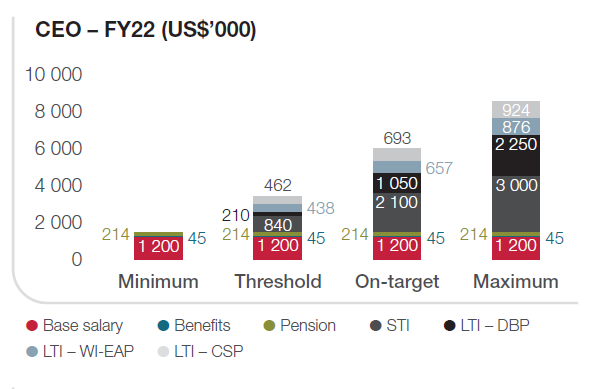
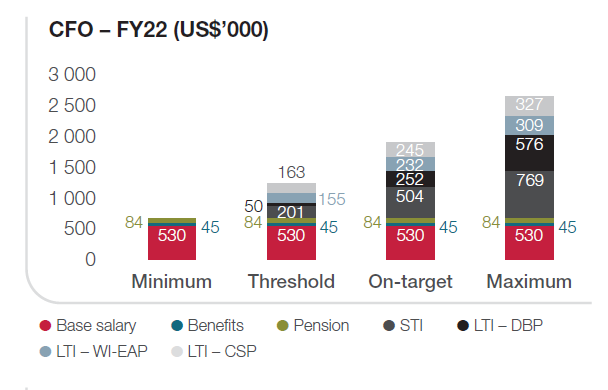
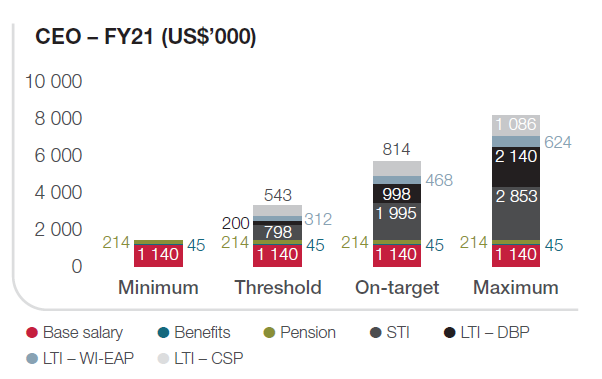

Under the minimum scenario the executives earn only their guaranteed package of base salary, benefits and Company pension contributions. All STI metrics are assumed to be below the lower guard-rail resulting in no STI payment and consequently no DBP deferral being possible. The CSP performance conditions are assumed to have not been resulting in no LTI value.
The threshold scenario includes the guaranteed package plus the minimum STI which would be earned if all STI metrics were triggered at the lower guard-rail threshold and 40% of on-target bonus was earned. It assumes that 25% of the bonus would be deferred into the DBP with the corporate co-investment applied. Under this scenario it is assumed that the CSP performance conditions are triggered three years after grant only at threshold level resulting in 50% vesting.
The on-target scenario assumes the achievement of STI targets and it assumes that 50% of the bonus will be deferred in the DBP with the corporate co-investment applied. In addition the CSP award is assumed to vest 75% (half-way between the threshold and maximum scenarios).
The maximum scenario assumes that all STI metrics are overachieved above the upper guard-rail resulting in the maximum STI being earned (which is 143% of the on-target STI for the CEO and 153% of the on-target STI for the CFO). This scenario also assumes the executives will defer the maximum proportion of their bonus, 75%, into the DBP with the corporate co-investment applied. For the CSP, the assumption is that all performance conditions are met at target level resulting in 100% vesting of the conditional share awards (there is no "over-performance" provision in the CSP).
It should be noted that the CSP and DBP components of the scenario analysis will only become available to the executives three and five years respectively after the financial year shown in the analysis. The LTI values shown in the above analysis are based on the share price at the date of grant and no discounting for the time value of money has been applied.
The annual grant of Datatec CSP conditional shares for the Datatec executives who participate in the Westcon International EAP is reduced by an "equivalence" factor to avoid "double dipping" in relation to reward opportunities. The equivalence factor was 36.5% for the May 2020 CSP grant in the FY21 figures above and 39.2% for the May 2021 CSP grant in the FY22 figures above. This reduction in the annual CSP grants is to take into account the potential benefit of the once-off Westcon International EAP grant in FY19 and consequently the potential benefit arising from the Westcon International EAP is illustrated in the above tables using the element of the CSP grant foregone by the CEO and CFO as a proxy for the notional increase in the value of the Westcon International EAP units, even though the one-off grant of Westcon EAP units was in FY19 before the years shown in the analysis.
Further scenario analysis of the executive directors' participation in the Westcon International EAP and the CSP grants foregone as a result is provided overleaf.
Westcon International EAP – Scenario analysis
As noted above, the executive directors of Datatec Group are also executives of Westcon International and they participated in the one-off grant of the Westcon International EAP in FY19 while continuing to participate in the Datatec CSP. The annual grant of Datatec CSP conditional shares for the Datatec executives is accordingly reduced by an "equivalence" factor to avoid double participation in relation to reward opportunities.
For the Datatec executives who participate in the Westcon International EAP an adjustment of 10% carried interest (CAGR) will be added to the equity base of US$125 million. This annually increasing threshold will be used for the equivalence factor calculation above.
The value of the potential outcome of the Westcon International EAP at 28 February 2023 (i.e. five years after starting) to the Datatec executives is shown below (prior to adjusting for the CSP grants foregone) for a range of compound annual growth rates of the value of Westcon International starting from the notional value of US$125 million on 1 March 2018.
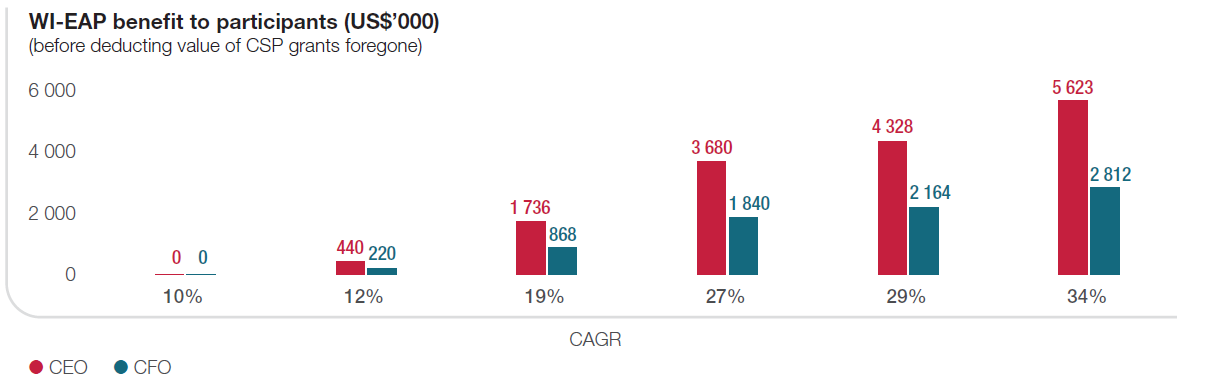
The benefit to participants in the above scenarios has been discounted to 28 February 2021 at a rate of 5% p.a.
The net benefit to participants must be considered after the deduction of the CSP grants foregone over the five-year period of the Westcon EAP. In the scenario analysis some assumptions need to be made for future events after 28 February 2021 to calculate the value of the CSP grants. The principal assumptions used to prepare the table below are:
(i) the Datatec share price will increase by 20% per annum CAGR; and
(ii) 60% of the CSPs will vest on average (i.e. performance conditions will be met for 60% vesting).
The table below shows the outcome for the same range of growth of Westcon International valuation from the notional starting value of US$125 million after deducting the economic value of the CSP awards foregone.

The net benefit to participants in the above scenarios has been discounted to 28 February 2021 at a rate of 5% p.a.
This analysis shows that the CEO and CFO will only benefit from the arrangement if the CAGR of Westcon International (above the notional starting point of US$125 million) over five years is around 20%. This equates to a valuation of approximately US$275 million for Westcon International on 28 February 2023.
Cap on the Westcon International EAP
The Remuneration Committee has determined that there will be a financial cap on the benefit the CEO and CFO can receive from their participation in the Westcon International EAP. The cap is based on the upper end of the scenarios above at which the Westcon International business is valued at/sold for US$400 million. The level of the cap is:
- CEO: US$6.6 million
- CFO: US$3.3 million.
These caps have not been discounted – they will apply at the determination date of the Westcon International EAP, 28 February 2023.
Shareholding guidelines
The Board has set out shareholding guidelines for executive directors whereby a shareholding with a market value of twice annual base salary should be held. The LTIs are intended to enable new executive directors to achieve this shareholding guideline over time.
Directors' service contracts
The employment contracts of executive directors are terminable at six months' notice by either party and contain contractual provisions for payment on termination covering the guaranteed package but no commitment relating to STI. The termination rules applicable to the LTIs are disclosed in the LTI section above.
All non-executive directors have letters of appointment with Datatec Limited. Under these contracts, non-executive directors retire in accordance with the MoI of the Company, which is at least every three years. Retiring directors may offer themselves for re-election.
Clawback and Malus Policy
The Board has instituted a clawback and malus policy with effect from 1 March 2020 based on simple and logical principles:
- The quantum of STIs received by directors is a function of the financial results of the Group as published in the annual financial statements.
- Participants' investment and the Company's co-investment in the DBP is a mathematical consequence of the STIs.
- The vesting of the CSP is conditional upon performance conditions which are likewise a function of metrics published in the annual financial statements.
- If the financial statements are incorrect, all the logic above is faulty and the clawback and malus policy will take effect to correct all the elements of remuneration which have been obtained based on the incorrect financial statements.
- The definition of incorrect financial statements which would trigger the policy is a material restatement ("restatement") of the Company's financial results as a result of material non-compliance with financial reporting requirements including fraud, wilful negligence and misrepresentation.
As the restatement of annual financial statements is a published event, the trigger of the clawback and malus policy will be well defined and the process of clawing back STI and LTI which had been based on the annual financial statement before restatement will be transparent.
The committee notes that eventualities other than those which cause a restatement of annual financial statements may also arise which could inflict reputational damage on the Company. It believes the Board's fiduciary responsibility and the committee's ability to apply discretion in exceptional circumstances will enable appropriate actions to be taken without needing to specifically address such scenarios in the clawback and malus policy.
External appointments of executive directors
Subject to the approval of the Board, executive directors are permitted to hold a directorship in one non-Group listed company and to retain the fees payable from such an appointment.
Non-executive directors' remuneration
The fee structure for non-executive directors, including the Chair, is recommended to the Remuneration Committee by executive management. It is periodically reviewed based on benchmarking studies prepared by external advisers using data from comparable companies and taking account of the international nature of the business.
For FY22, a 5% increase in non-executive directors' annual fees is proposed and will be put to shareholders for approval at the AGM on 29 July 2021. The fees for FY21 are set out in the implementation report below.
The Chair's fee covers his role on the Board and its committees and attendance at subsidiary board meetings and shareholder meetings as required. Other non-executive directors receive a fee for their Board role plus fees for membership/chairship of individual committees.
The terms and conditions of appointment of non-executive directors are available on request from the Company Secretary. Non-executive directors are not eligible to participate in the annual bonus plan or any of the Datatec share incentive schemes.
The operation of the Group's remuneration policy in FY21 is described in the implementation report later in this remuneration report.
Approval of the remuneration policy:
The FY20 remuneration policy was put before shareholders for an advisory vote at the AGM on 29 July 2020 and received support from 91.5% of shares voted.
Shareholder consultation undertaken in July 2021 as noted in part 1 of this Report will be used to inform further refinements to the policy.
The remuneration policy set out herein will be put before shareholders for an advisory vote at the 2021 AGM.
The Remuneration Committee is committed to continuing open, constructive dialogue with shareholders.
Part 3: Remuneration implementation
Base pay adjustments
For FY21, the base salary for the executive directors was unchanged from FY20 levels in light of the uncertainty arising from the Covid-19 crisis.
For FY22, the Remuneration Committee has increased the base salary for the executive directors by 5%.
Datatec Group short-term incentives
The FY21 STI bonus structure comprised Company and individual performance targets. The outcome is set out in the table below.
The committee assessed achievement against the personal KPI goals as follows:
For the CEO:
- Covid-19 crisis management – covering all aspects of the Group's response to the pandemic - the Group's response to the Covid-19 crisis was very well managed and the committee assessed this KPI as overachieved at 17% (target 15%);
- Culture/leadership – qualitative measure assessed by the Remuneration Committee considering how the executive director has led the Group while promoting its values and Code of Conduct. This was assessed to be on-target at 5%;
- Post Covid-19 crisis strategy – development of the Group's operational and organisational strategy for the "new normal" post the pandemic. The committee assessed that the "new normal" is still unclear and confirmed the metric had been achieved on target at 10% (target 10%).
For the CFO:
- Covid-19 crisis management – covering all aspects of the Group's response to the pandemic - the Group's response to the Covid-19 crisis was very well managed and the committee assessed this KPI as overachieved at 17% (target 15%);
- Westcon International refinancing – The target was to achieve a refinancing on favourable terms. This was successfully completed in August 2020 with the new €275 million (US$320 million) facility for Westcon Europe provided by a banking syndicate, led by Crédit Agricole Leasing & Factoring ("CAL&F"), and by the two-year US$80 million new receivables securitisation facility for Westcon International's Asia-Pacific subsidiaries. The new facilities were significantly larger than the previous facilities and refinanced at substantially better terms than the previous facilities, under extremely difficult market conditions. In the Remuneration Committee's evaluation this KPI had been overachieved at 12% (target 10%);
- External auditor transition – PwC replaced Deloitte as the Group's external auditor from the FY21 financial year. The Remuneration Committee's assessment was that the transition from Deloitte to PwC had been highly successful, especially during the period from March to May 2020 in a very difficult environment (as this was immediately after Covid-19 was declared a global pandemic by the WHO) when all parties were required to work remotely. Accordingly, the KPI achievement was agreed to be 6% (target 5%).
FY21 Bonus
| 1) Underlying earnings per share | US cents | Bonus | Target | Outcome | ||||||
| Lower guard-rail | -33% | 3.0 | 40% | 25% | 40.0% | |||||
|---|---|---|---|---|---|---|---|---|---|---|
| On target | Target | 4.5 | 100% | |||||||
| Upper guard-rail | 33% | 6.0 | 160% | |||||||
| Actual | 13.6 | 160% | ||||||||
| 2) Adjusted* EBITDA | US$ million | Bonus | ||||||||
| Lower guard-rail | -50% | 50 | 40% | 25% | 37.3% | |||||
| On target | Target | 100 | 100% | |||||||
| Actual | 141 | 149% | ||||||||
| Upper guard-rail | 50% | 150 | 160% | |||||||
| 3a) Logicalis net overdraft – H1** | US$ million | Bonus | ||||||||
| Lower guard-rail | 25% | -40 | 40% | 5% | 8.0% | |||||
| On target | Target | -32 | 100% | |||||||
| Upper guard-rail | -25% | -24 | 160% | |||||||
| Outcome achieved H1 | 54 | 160% | ||||||||
| 3b) Logicalis net cash – H2** | US$ million | Bonus | ||||||||
| Lower guard-rail | 25% | 23 | 40% | 5% | 4.0% | |||||
| Outcome achieved H2 | 27 | 80% | ||||||||
| On target | Target | 30 | 100% | |||||||
| Upper guard-rail | -25% | 38 | 160% | |||||||
| 4a) Westcon net working capital days – H1** | Days | Bonus | ||||||||
| Lower guard-rail | 10% | 33 | 40% | 5% | 8.0% | |||||
| On target | Target | 30 | 100% | |||||||
| Upper guard-rail | -10% | 27 | 160% | |||||||
| Outcome achieved H1 | 17 | 160% | ||||||||
| 4b) Westcon net working capital days – H2** | Days | Bonus | ||||||||
| Lower guard-rail | 10% | 22 | 40% | 5% | 8.0% | |||||
| On target | Target | 20 | 100% | |||||||
| Outcome achieved H2 | 18 | 160% | ||||||||
| Upper guard-rail | -10% | 18 | 160% | |||||||
| 5) Personal KPIs | CEO | CFO | ||||||||
| As evaluated by the Remuneration Committee. See comments below. | 30% | 32.0% | 36.0% | |||||||
| Total on-target bonus | 100% | 137.3% | 141.3% | |||||||
| * | Adjusted means excluding all restructuring costs. |
| ** | Based on budget for the six months. |
Because the FY21 bonus for both CEO and CFO is above the on-target bonus, the executive directors are required to defer a mandatory minimum of one-third of their FY21 bonus into the DBP.
See section 'Deferred Bonus Plan to be awarded during FY22' for details.
The targets and outcomes of the annual bonuses of the executive directors for FY21 shown as a percentage of base salary and split by the bonus elements, are illustrated below.
CEO FY21 bonus composition as a percentage of basic salary

CFO FY21 bonus composition as a percentage of basic salary

The metrics for the executive directors' STI in FY22 are set out in part 2 of this remuneration report.
Datatec Group long-term incentives awarded during FY21
Conditional Share Plan awarded during FY21
The annual grant of CSP awards was made on 1 June 2020 following approval by the Remuneration Committee. The awards will vest after three years subject to the Group meeting certain performance conditions set by the Remuneration Committee. The performance conditions used for the FY21 award are in line the policy communicated in the FY20 remuneration report, namely:
| PERFORMANCE CONDITIONS AND WEIGHTING | THRESHOLD – 50% VESTING | MAXIMUM – 100% VESTING | ||||||||||||||||||
| TSR – 2/3rds, calculated as follows: Where:
|
TSR must exceed 11.34% which was the Company's weighted average cost of capital as at 29 February 2020, as measured over a three-year performance period. | TSR must equal or exceed 13.34%, as measured over a three-year performance period. | ||||||||||||||||||
uEPS – one-third |
uEPS must grow by the rate of US CPI inflation +2% CAGR per annum over the three-year performance period starting from the reported uEPS for FY20 of 9.9 US cents. | uEPS must grow by the rate of US CPI inflation +4% CAGR per annum over the three-year performance period starting from the reported uEPS for FY20 of 9.9 US cents. | ||||||||||||||||||
Linear vesting applies between threshold and maximum levels.
Executive directors' CSP awards are as follows:
| Number of awards |
||||||||
| CSP | Grant date |
At 29 Feb 20 |
FY21 | Fair value of awards on grant US$'000 |
Grant fair value as % of base pay |
Fair value of awards at 28 Feb 21 US$'000 |
Fair value of awards at 29 Feb 20 US$'000 |
|
| JP Montanana | 1 Jun 18 | 1 291 148 | 2 142 | 150 | 1 096 | 277 | ||
|---|---|---|---|---|---|---|---|---|
| 1 Jun 19 | 538 870 | 1 246 | 109 | 91 | 115 | |||
| 1 Jun 20 | 782 719 | 1 086 | 95 | 886 | - | |||
| 2 073 | 392 | |||||||
| IP Dittrich | 1 Jun 18 | 405 066 | 672 | 120 | 344 | 87 | ||
| 1 Jun 19 | 190 212 | 344 | 87 | 32 | 41 | |||
| 1 Jun 20 | 276 286 | 383 | 76 | 313 | – | |||
| 689 | 128 | |||||||
The fair value of these awards at date of grant was R24.12 (FY20: R33.05) per award being the 30-day volume-weighted average share price on the day of the Group's FY20 results announcement. The fair value as at 28 February 2021 is based on the 30-day volume-weighted average share price on 28 February 2021 (R25.67) multiplied by an estimate of the performance conditions being achieved. For the 2018 awards vesting in June 2021, 50% vesting is assumed. For the 2019 awards, the fair value assumes 10% vesting of the awards, i.e. that the performance condition targets will only be 10% achieved, the same assumption as in the prior year. For the 2020 awards, the fair value assumes 67% vesting of the awards, i.e. that the performance condition targets will only be 67% achieved. The actual value of any benefit received by the directors from these CSPs will be reported in future remuneration reports when the awards vest.
Deferred Bonus Plan awarded during FY21
Executive directors deferred part of their FY20 bonuses under the terms of the DBP in June 2020. In accordance with the policy, a co-investment equal to the amount of deferred bonus was provided by the Company and the total amount was applied to purchase Datatec shares in accordance with the policy.
Executive directors' holdings in the DBP are shown in the table below:
| DBP | Bonus year |
Grant date |
Amount of bonus deferred |
Company co- investment US$'000 |
Total invested in shares US$'000 |
Total number of shares purchased |
Fair value of awards on grant US$'000 |
Fair value of awards at 28 Feb 21 US$'000 |
Fair value of awards at 29 Feb 20 US$'000 |
||
| % | US$'000 | ||||||||||
| JP Montanana | FY18 | Jun 18 | 83.3 | 837 | 837 | 1 675 | 1 000 000 | 1 675 | 1 698 | 2 142 | |
|---|---|---|---|---|---|---|---|---|---|---|---|
| FY19 | Jun 19 | 50.0 | 812 | 812 | 1 624 | 702 407 | 1 624 | 1 192 | 1 504 | ||
| FY20 | Jun 20 | 37.3 | 300 | 300 | 600 | 432 353 | 600 | 734 | – | ||
| 2 134 760 | 3 899 | 3 624 | 3 646 | ||||||||
| IP Dittrich | FY18 | Jun 18 | 20.4 | 40 | 40 | 80 | 47 000 | 80 | 80 | 101 | |
| FY19 | Jun 19 | 25.0 | 96 | 96 | 191 | 82 636 | 191 | 140 | 177 | ||
| FY20 | Jun 20 | 25.0 | 48 | 48 | 96 | 69 317 | 96 | 118 | – | ||
| 198 953 | 367 | 338 | 278 | ||||||||
| 2 333 713 | 4 266 | 3 962 | 3 924 | ||||||||
The fair value of these awards at date of grant was the share price at which the DBP shares were purchased on the dates shown in the table. The fair value as at 28 February 2021 is R25.67 (FY20: R33.44) being the 30-day volume-weighted average share price on 28 February 2021.
The DBP shares above are included in the directors' shareholdings as at 28 February 2021 disclosed later in this report.
The fair value of the Company co-investment shares purchased in relation to the DBP is shown as LTI in total remuneration for the financial year in which the bonus (STI) was earned.
The value of dividends received on the above DBP shares was:
| Dividends | FY21 US$'000 |
FY20 US$'000 |
|
| JP Montanana | – | 120 185 | |
|---|---|---|---|
| IP Dittrich | – | 9 152 |
Deferred Bonus Plan to be awarded during FY22 based on the FY21 STI outcomes
Executive directors have deferred part of their FY21 bonuses under the terms of the DBP. In accordance with the policy, an equal co-investment from the Company was applied to the deferred bonus amount and Datatec shares will be purchased.
| DBP | FY22 Grant date (expected) |
Amount of bonus deferred |
Company contribution US$'000 |
Total invested in shares US$'000 |
Fair value of awards on grant US$'000 |
||
| % | US$'000 | ||||||
| JP Montanana | Jun 21 | 37.9 | 1 039 | 1 039 | 2 078 | 2 078 | |
| IP Dittrich | Jun 21 | 33.3 | 225 | 225 | 450 | 450 | |
The table above shows the monetary amount of the FY21 STI deferral and Company co-investment to be used to purchase Datatec shares in June 2021. The fair value of the Company co-investment shares purchased in relation to the DBP is shown as LTI in total remuneration for the FY21 financial year in which the bonus (STI) was earned.
Directors' interests in subsidiary share schemes – awarded during FY19
The executive directors received one-off awards under the Westcon International EAP in FY19 by virtue of their leadership roles as CEO and CFO of Westcon International (in addition to their Datatec roles). The Westcon International EAP is explained in part 2 of this remuneration report. The Datatec executives who participate in the Westcon International EAP will have an adjustment made to the threshold of 10% carried interest (CAGR) annually added to the equity base of US$125 million and their ultimate pay-out from the plan, if any, is capped as described in the policy section above.
| Westcon EAP | Grant date (FY19) |
Number of awards |
Fair value of awards on grant US$'000 |
Grant fair value as % of base pay US$'000 |
Fair value of awards at 28 Feb 21 US$'000 |
Fair value of awards at 29 Feb 20 US$'000 |
|
| JP Montanana | 14 Mar 18 | 30 000 | – | – | 1 625 | 102 | |
|---|---|---|---|---|---|---|---|
| IP Dittrich | 14 Mar 18 | 15 000 | – | – | 812 | 51 |
In addition to the above, Datatec granted Mr Montanana a conditional award equivalent to 10 000 Westcon International EAP units on 14 March 2018. This award is conditional on a sale of Westcon International for US$300 million or more. If that condition is met Mr Montanana will receive a cash payment from Datatec equivalent to the value of 10 000 units of the Westcon International EAP. The award will have the same adjustment made to the threshold, 10% carried interest (CAGR) annually added to the equity base of US$125 million, as the other Westcon International EAP awards provided to Datatec executives. This award had a fair value of US$750 000 as at 28 February 2021 (FY20: US$37 000).
The fair value of the Westcon EAP awards on grant was deemed to be nil because the value of Westcon International based on book value was below the equity base threshold of US$125 million. The fair value of the Westcon International EAP awards as at 28 February 2021 was determined by an actuarial calculation.
Previous Datatec Group share schemes
The previous Datatec Group share schemes, the SARS, LTIP and old DBP, operated from 2005 with some modifications approved by shareholders in 2010 and 2011. The last grants under these schemes were in July 2017 (in FY18) and thereafter they were superseded by the CSP and new DBP. Existing grants under the previous share schemes remained active for the three-year performance periods and details of the operation of the previous share schemes have been provided in past remuneration reports. An update on the final vesting during FY21 is given below.
Datatec Share Appreciation Rights Scheme
The SARs granted in May 2017 ("2017 SARs") were assessed for vesting in May 2020. The performance condition set by the Remuneration Committee was that the Datatec share price (30-day VWAP) growth from 1 March 2017 to 28 February 2020 was required to be in excess of South African CPI. This is a market performance condition.
The performance condition was not met and therefore the 2017 SARs lapsed in May 2020 (during FY21).
Directors' interests in Datatec SARs are shown in the following table:
| Grant date | Grant price (ZAR) |
SARs held at beginning of year |
Exercised during the year |
Lapsed during the year |
SARs held at year-end |
Status at 28 Feb 21 |
Fair value of awards at 28 Feb 21 US$'000 |
||
| JP Montanana | 14 May 15 | 35.79 | 629 000 | – | – | 629 000 | Vested | – | |
|---|---|---|---|---|---|---|---|---|---|
| 28 Jul 17 | 34.94 | 748 955 | – | 748 955 | – | Lapsed | – | ||
| Sub-total | 1 377 955 | – | 748 955 | 629 000 | – | ||||
| IP Dittrich | 28 Jul 17 | 34.94 | 230 039 | – | 230 039 | – | Lapsed | – | |
| Sub-total | 230 039 | – | 230 039 | – | – | ||||
| Total | 1 607 994 | – | 978 994 | 629 000 | – |
The SARs granted in May 2015 (during FY16) vested during FY19 and this is the only remaining vested SARs award. Its fair value as at 21 February 2021 is nil because the grant price exceeds the share price at 28 February 2021.
Datatec Long-Term Incentive Plan
The last conditional awards under the LTIP were assessed for vesting in May 2020 as set out in detail in the FY20 remuneration report. The movement in directors' holding during FY21 is shown in the following table:
| Awards held at beginning of year |
Vested and settled during the year |
Lapsed/ forfeit during the year |
Awards held at year-end |
||
| JP Montanana | 1 310 090 | 1 310 090 | – | – | |
|---|---|---|---|---|---|
| IP Dittrich | 288 278 | 288 278 | – | – | |
| Total | 1 598 368 | 1 598 368 | – | – |
The value of the Datatec shares delivered to directors as a result of their LTIP awards vesting was as follows:
| FY21 US$'000 |
FY20 US$'000 |
||
| JP Montanana | 1 717 877 | 1 271 791 | |
|---|---|---|---|
| IP Dittrich | 378 009 | 262 341 |
Dilution attributable to Datatec Group share incentive plans
In practice, the Company has not issued new shares in settlement of share schemes in the recent past and has no intention to do so in the near future. Instead, shares for settlement of share schemes are purchased in the market.
If new shares were to be issued to settle expected vesting of outstanding CSP awards, the dilution arising would be 1.23% (FY20 0.82% - dilution only from the LTIP).
The DBP does not give rise to any dilution effect because forfeitable shares are granted to participants at the start of the holding period and settled using shares purchased in the market. However, the forfeitable shares are treated as treasury shares until vesting.
None of the divisional share-based remuneration plans could have any dilution effect as they are not settled with Datatec shares.
Single figure remuneration of executive directors
The following tables show the composition of a single figure of remuneration for the executive directors:
| CEO | CFO | |||||
| Component | FY21 US$'000 |
FY20 US$'000 |
FY21 US$'000 |
FY20 US$'000 |
||
| Old LTI | SARS | – | – | – | – | |
|---|---|---|---|---|---|---|
| LTIP | – | 2 806 | – | 617 | ||
| DBP | – | – | – | – | ||
| New LTI | CSP | 1 096 | 344 | |||
| DBP | 1 039 | 300 | 225 | 48 | ||
| Total LTI | 2 135 | 3 106 | 569 | 665 | ||
| STI | FY18 – cash | – | 59 | – | 15 | |
| FY20 – cash | – | 503 | – | 144 | ||
| FY20 – deferred | – | 300 | – | 48 | ||
| FY21 – cash | 1 700 | – | 450 | – | ||
| FY21 – deferred | 1 039 | – | 225 | – | ||
| Sub-total STI | 2 739 | 862 | 675 | 207 | ||
| Pension | 214 | 214 | 84 | 84 | ||
| Benefits | 55 | 48 | 46 | 47 | ||
| Base salary | 1 140 | 1 140 | 503 | 503 | ||
| Guaranteed package | 1 409 | 1 402 | 633 | 634 | ||
| 6 283 | 5 370 | 1 877 | 1 506 | |||
Old LTI
The final vesting of LTIPs is included in FY20.
DBP and CSP
The value of the shares purchased by the Company equal to the amount of bonus deferred by the Directors in respect of their bonuses for FY21 and FY20 is shown in the table.
The CSP remuneration shown for FY21 arises from the vesting of the June 2018 CSP in June 2021, valued at the 30-day VWAP of Datatec shares as at 28 February 2021.
STI
The STI shown above is split between the element deferred into the DBP and the element paid in cash after publication of the Group results.
A deferred element of the FY18 bonus relating to the SYNNEX transaction earn-out was paid during FY20 and is disclosed separately in the table.
Non-executive directors' remuneration
During FY21, non-executive directors received the following fees which have remained unchanged for three consecutive years:
| Role | FY21 fee US$ |
|
| Chair of the Board (total fee inclusive of all committee and subsidiary board work) | 201 552 | |
|---|---|---|
| Senior non-executive director | 74 256 | |
| Non-executive director | 63 648 | |
| Chair of the Audit, Risk and Compliance Committee | 31 824 | |
| Member of the Audit, Risk and Compliance Committee | 15 912 | |
| Chair of the Social and Ethics Committee | 10 608 | |
| Chair of the Remuneration Committee | 15 912 | |
| Member of the Remuneration Committee | 7 956 | |
| Member of the Nominations Committee | 5 304 | |
| Chair of Datatec Technology and Education Foundation | 12 000 |
These fees were approved by shareholders at the AGM on 29 July 2020. Non-executive directors are reimbursed for travel costs necessary for attending Board meetings and do not receive any employment benefits.
For the year ending 28 February 2022, the Remuneration Committee proposes a 5% increase in fees for non-executive directors to the following levels:
| Role | FY22 fee proposed US$ |
|
| Chair of the Board (total fee inclusive of all committee and subsidiary board work) | 211 640 | |
|---|---|---|
| Senior non-executive director | 78 000 | |
| Non-executive director | 66 860 | |
| Chair of the Audit, Risk and Compliance Committee | 33 420 | |
| Member of the Audit, Risk and Compliance Committee | 16 710 | |
| Chair of the Social and Ethics Committee | 11 140 | |
| Member of the Social and Ethics Committee | 5 570 | |
| Chair of the Remuneration Committee | 16 710 | |
| Member of the Remuneration Committee | 8 360 | |
| Member of the Nominations Committee | 5 570 | |
| Chair of Datatec Technology and Education Foundation | 12 600 |
These fees will be presented for approval by shareholders at the AGM on 29 July 2021.
Summary of directors' remuneration
The remuneration of directors serving on the Board in FY21 and FY20 is shown in the following tables:
| FY21 | ||||||||
| Guaranteed package | ||||||||
| US$'000 | Basic salary |
Pension | Other benefits |
Fees | STI | LTI | Total | |
| Executive directors | ||||||||
| JP Montanana | 1 140 | 214 | 55 | – | 2 739 | 2 135 | 6 283 | |
| IP Dittrich | 503 | 84 | 46 | – | 675 | 569 | 1 877 | |
| Total executive directors | 1 643 | 298 | 101 | – | 3 414 | 2 704 | 8 160 | |
| Non-executive directors | ||||||||
| SJ Davidson | – | – | – | 202 | – | – | 202 | |
| M Makanjee | – | – | – | 102 | – | – | 102 | |
| JF McCartney | – | – | – | 75 | – | – | 75 | |
| CRK Medlock | – | – | – | 80 | – | – | 80 | |
| MJN Njeke | – | – | – | 103 | – | – | 103 | |
| E Singh-Bushell | – | – | – | 101 | – | – | 101 | |
| Total non-executive directors | – | – | – | 663 | – | – | 663 | |
| Total directors' emoluments | 1 643 | 298 | 101 | 663 | 3 414 | 2 704 | 8 823 | |
| FY20 | ||||||||
| Guaranteed package | ||||||||
| US$'000 | Basic salary |
Pension | Other benefits |
Fees | STI | LTI | Total | |
| Executive directors | ||||||||
| JP Montanana | 1 140 | 214 | 48 | – | 862 | 3 106 | 5 370 | |
| IP Dittrich | 503 | 84 | 47 | – | 207 | 665 | 1 506 | |
| Total executive directors | 1 643 | 298 | 95 | – | 1 069 | 3 771 | 6 876 | |
| Non-executive directors | ||||||||
| SJ Davidson | – | – | – | 202 | – | – | 202 | |
| M Makanjee | – | – | – | 93 | – | – | 93 | |
| JF McCartney | – | – | – | 101 | – | 15 | 116 | |
| CRK Medlock (from 1 January 2020) | – | – | – | 13 | – | – | 13 | |
| MJN Njeke | – | – | – | 109 | – | – | 109 | |
| E Singh-Bushell | – | – | – | 99 | – | – | 99 | |
| Total non-executive directors | – | – | – | 617 | – | 15 | 632 | |
| Total directors' emoluments | 1 643 | 298 | 95 | 617 | 1 069 | 3 786 | 7 508 | |
Note: the non-executive directors' fees shown above exclude VAT.
The implementation of remuneration during FY21 as set out above has been in compliance with the policy in part 2.
The FY20 remuneration implementation report was put before shareholders for an advisory vote at the AGM on 29 July 2020 and received support from 87.22% of shares voted.
This FY21 remuneration implementation report will be put before shareholders for an advisory vote at the 2021 AGM.