Datatec social investment report
Understanding that our moral imperative is to address the critical needs of our nation, Datatec is committed to empowering those, who need it most, through education. Despite insurmountable challenges brought by Covid-19, the Datatec Educational and Technology Foundation has witnessed remarkable outcomes among young men, women and children in several grassroots programmes the Foundation continues to support.
Overview of the Foundation
The Foundation carries a proud history of funding education, specifically in science, technology, engineering and mathematics (“STEM”) subjects, in severely under-resourced communities across South Africa.
Recognising the critical need for STEM-based professionals, the country’s deepening maths and physical science education crisis requires creative interventions.
In response to this, the Foundation has developed long-term funding partnerships with non-profit organisations (“NPOs”) which focus on STEM development. In certain instances, they support psychosocial development among learners in townships across Gauteng, the Eastern Cape and the Western Cape. Funding is then allocated to school-level intervention programmes for learners and teachers, psychosocial development, technology infrastructure, skills development for unemployed youth, or tertiary ICT education offered by our partners.
Our programmes
Kutlwanong Promaths
Using a multi-pronged approach, Kutlwanong’s Promaths learner programme provides additional maths and science tuition to Grade 10, 11 and 12 township students. In FY21, the Foundation supported 210 learners in Promaths’ Eastern Cape Mdantsane centre. The centre supports students from rural and township schools in the area. The Foundation partnered with Promaths more than a decade ago to establish the Mdantsane centre and continues to be the principal funder for the project in this region. Promaths also focuses on upskilling teachers by providing teaching aids to help educators deliver lessons in a more engaging, memorable way. The programme’s content is aligned with the National Department of Education’s curriculum. Thus, learners can practice in a highly relevant, appropriate manner.
OLICO Maths Education
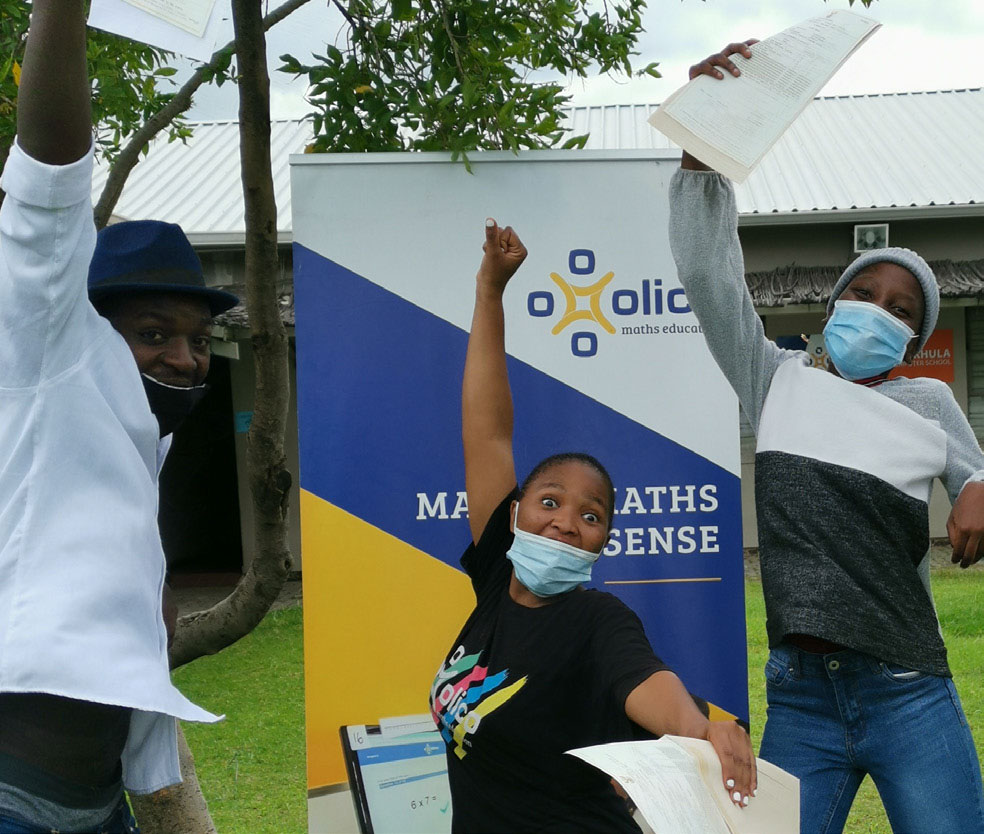
OLICO provides a blended use of extracurricular maths tutoring and custom-built online maths programmes for Grade 7 to 9 learners, alongside maths clubs aimed at primary-school learners (Grades R – 6). OLICO works with over 180 high-school learners a year from Diepsloot, of whom 20-25 are matriculants. OLICO is trying to grow its reach in the township, increasing the number of high schools it is involved with from two to four. By 2024 it hopes to secure at least 100 Bachelor-level maths passes in a matric year (500% growth over the next four years). The Foundation funds the programme director’s annual salary.
Tomorrow Trust
The Tomorrow Trust is an NPO that supports orphaned and vulnerable children throughout their educational journey. It focuses on academics and life skills. The organisation, which works in townships across Gauteng and the Western Cape, also runs the Shift Initiative, which equips learners to meet some of the challenges specifically associated with the Fourth Industrial Revolution. These include digitised tuition in digital literacy, coding, gaming and robotics. The Tomorrow Trust also runs several other holistic education programmes throughout the year at various host-partner venues, including a tertiary and alumni programme. In FY21, the Foundation supported 30 grade 9 and 30 grade 11 learners.
Maharishi Institute
Using its core ideology of consciousness-based education to develop the potential of every student, the non-profit private college and self-development organisation in Johannesburg and Cape Town provides bursaries and self-development programmes for bright, deserving youth to further their studies. The Institute assists them to find employment opportunities when they graduate. The qualifications they offer are accredited through various SETAs in South Africa. In FY21, the Foundation made a contribution towards the development of five new national certificates and their accreditation with various SETAs. Further contributions were made towards the successful move of academic programmes online and towards personal protective equipment for the Institute.
Belgium Campus iTversity
Belgium Campus is a pioneering ITversity in South Africa that helps to raise the bar in private education through its graduates in the ICT industry. Courses offered include a Bachelor of Computing and Bachelor of Information Technology. The Foundation sponsored three female students from previously disadvantaged communities in a Bachelors programme.
The Vula programme at Hilton College
The Vula programme, based in KwaZulu-Natal, is a beneficiary project of the Foundation. It was established in 2001 by the Hiltonian Society, which owns Hilton College, to fund NPOs providing professional development to teachers as well as organisations at secondary-school level. The programme is focused on improving results in mathematics, science and English. The programme interacts with teachers from eight of the 13 educational districts in KZN to help to improve the teaching of mathematics and physical science. The Foundation sponsored 17 teachers to attend the Vula Maths Academy in FY21 and contributes to overheads associated with the Vula programme.
Afrika Tikkun
An established and well-known NPO in South Africa, they aim to reduce unemployment by empowering young people in the context of family. Their focus is on education, personal development, nutrition, health, family support, skills development and work placement. Core programmes include Early Childhood Development, Child and Youth Development, and Career Development. Student programmes encompass Primary Health Care, Family Support, Nutrition and Food, and Empowerment. 100 iPads were purchased by the Foundation to support the eLearning programme for the Youth Development programme.
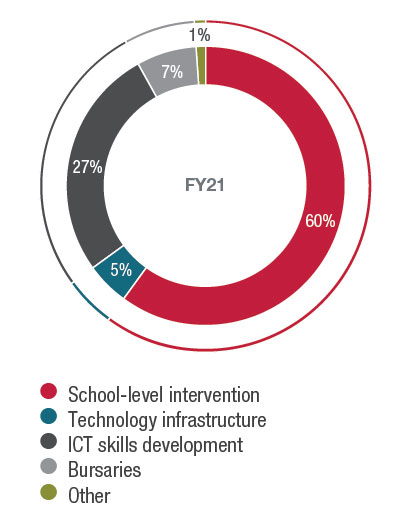
CSI spend by project type
A hybrid model of education and care: A new way of thinking?
The pandemic presented our beneficiary programmes with incredible challenges. Yet on reflection, each one of them overcame the odds to continue providing teaching, development and care that learners needed to achieve the results they did. It also provided them with a golden opportunity: how to adapt their existing model of teaching and care to address distance-learning needs which potentially, in the long-run, could further their reach and effectiveness.
In some instances, the programmes comfortably transitioned to online methods, and in other instances they struggled. This has however set a precedent which has redefined how they think and how they will develop going forward.
A snapshot of the success achieved by the beneficiaries of the Foundation:
- WhatsApp proved to be effective with keeping learners engaged and learning.
- South Africa’s four major telco providers zero-rated OLICO’s online maths portal allowing access without incurring data costs.
- A new online learning pathway on OLICO’s maths portal now aligns to the revised curriculum recovery plans.
- A number fluency app for entry-level Android devices was published. Using this app, OLICO hosted a live virtual Times-Tables Challenge over Zoom.
- Tomorrow Trust partnered with the LEGO Foundation to create a National Teacher Platform whose goal is to create a messaging service that provides resources for all learners and teachers throughout South Africa.
- 40 Zoom classes were provided to each grade by the Tomorrow Trust, with 675 GB data provided to educators, learners and tertiary students.
- All Grade 10, 11, and 12 learners received iPad devices from Tomorrow Trust.
- Kutlwanong Promaths launched a Grade 12 maths and physical sciences virtual learning environment platform.
The Foundation spent R9 million on various projects with a focus on school-level intervention.
SUCCESS STORIES
Three young tech students beat lockdown challenges to fulfil their dreams
Three young South African women have risen above difficult circumstances exacerbated by the Covid-19 lockdowns last year to keep up with demanding study schedules and remain an inspiring force for their families and friends. Glory Matshete (28) from the North West province, Sibaxolise Mningiswa (20) from the Eastern Cape and Maishibe Thobela (20) from Gauteng are now in their third year of a three-year Bachelor of Information Technology degree at ITversity Belgium Campus, sponsored by the Foundation. The three women are aiming to carve out IT careers in the fields of STEM.
Navigating the tricky lockdown landscape over the last 12 months hasn’t been easy. Belgium Campus quickly scaled activities to allow students to attend lectures online using Microsoft Teams and Zoom videoconferencing. It wasn’t a trouble-free transition, with the challenges of lack of equipment and a stable power supply, unreliable internet connectivity and sometimes unaffordable data. “The change from quiet campus life to studying back at home with my folks and family in the background was a big one,” admits Glory. But failure simply wasn’t an option. “My mother was really my champion. Every time life knocks her down, she just gets back up and tries once more.”
For Sibaxolise, there was self-doubt and procrastination: not having the person-to-person support of her study mates, she had to find a way of muscling up self-motivation. To manage her overall workload, plotting a timetable and then actually actioning it (rather than “using it for decoration”, she jokes) made a big difference. “Talking to my mom, listening to Steve Harvey and watching TED Talks also helped.” If she was unsure of something in her coursework, she’d take a picture of what she was grappling with and email it to her lecturer, who would guide her.
It was time management and navigating distractions that challenged Maishibe. “Being locked down at home came with household responsibilities, which meant that I had less of my own time. I had to negotiate with my parents so that they understood that my academics were my priority.” That said, her father, with his steadfast work ethic and desire to see others succeed, enabled her to keep focus, says Maishibe, whose life goals are “to make a difference in other people’s lives, along with becoming the most generous person ever”.