 AR
AR Downloads
 Glossary
 Search


Remuneration report

Our committee is focused on ensuring that the remuneration structures at Datatec drive value creation for our stakeholders, with a reward framework and value proposition for our executives which is in accordance with ethical corporate governance standards.
Stephen Davidson
Social and Ethics Committee report
Part 1 - Background statement
Introduction
On behalf of the Board of Directors and the Remuneration Committee, I am pleased to present the remuneration report ("the report") for 2023.
The Remuneration Committee aims to ensure that Datatec remunerates fairly, responsibly and transparently to promote the achievement of strategic objectives and positive outcomes in the short, medium and long term (King IV Principle 14). Our committee is focused on ensuring that the remuneration structures at Datatec drive value creation for our stakeholders, with a reward framework and value proposition for our executives which is in accordance with ethical corporate governance standards. We are satisfied that our policies are aligned with shareholder value creation.
Our performance and pay outcomes in FY23
The Group maintained strong operational and financial performance during FY23. Pursuant to our Strategic Review process seeking to unlock value for shareholders, we sold Analysys Mason in September 2022 and returned the sale proceeds to shareholders by means of a special dividend of US$158 million.
The performance of Westcon International during FY23 was excellent representing a continuation of the impressive turnaround and development of the business which has been achieved since the sale of Westcon Americas in 2018.
The main remuneration outcomes in FY23 are as follows with the detail set out in the Policy and Implementation sections of this report:
- Executives received no increase in guaranteed pay for FY23
- Likewise, non-executive directors' fees were not increased
- Short-term incentives ("STIs") earned for FY23 reduced compared to FY22 primarily because the underlying earnings per share ("uEPS") target was not met
- The Westcon International Equity Appreciation Plan ("EAP") crystallised in March 2023 with significant reward for Westcon International management and the Datatec executive directors which are included in FY23 remuneration in this report
- The Conditional Share Plan ("CSP") awards granted in May 2020 with a performance period that ended 28 February 2023 vested at 100%, because total shareholder return ("TSR") and uEPS growth target performance conditions were achieved
Performance and pay targets for FY24
The main remuneration targets and outlook are summarised below with the detail set out in the Policy and Implementation sections of this report:
- No changes have been made to the remuneration policy for FY24
- Executives received a 6% increase in basic pay for FY24 having received no increase for FY23
- Likewise, non-executive directors received a 6% increase in fees for FY24 having received no increase for FY23
- STI – the weighting of metrics has changed slightly:
- Added a working capital metric for Logicalis Latin America ("LATAM") (5% of the on-target bonus)
- Personal key performance indicators ("KPIs") consequently reduced to 20% of the on-target bonus (from 25%)
- The weightings for the remainder of the metrics remain unchanged from FY23
- Long-term Incentive ("LTI")
- CSP awards will be made in line with our policy - the absolute TSR performance condition was the sole performance condition for the grant in June 2023
- Deferred bonus warrant ("DBW") grants of share appreciation rights ("SARs") will be made in June 2023 as co-investment with participants' acquisition of shares with part of their FY23 bonuses
An important development in FY24 is the implementation of new management incentive plans for Logicalis International and Westcon International, the latter succeeding from the EAP.
Linking pay to our strategy
In August 2021, Datatec announced a comprehensive Strategic Review to consider options and initiatives to unlock and maximise shareholder value going forward. The Strategic Review aims to address the persistent gap between Datatec's valuation and the inherent value of its underlying assets while also ensuring that the Group is positioned to take full advantage of the positive market dynamics for its technology solutions and services. In parallel, the strategy of pursuing a combination of corporate and business actions aimed at enhancing the competitiveness and profitability of our subsidiaries and operating divisions in order to enhance value remains in place.
The Group's remuneration policy seeks to align remuneration to the achievement of the Group's strategic objectives.
| Aligning remuneration to our strategic objectives | |||||
| Strategic objective | Short-term incentive | Long-term incentive | |||
| Value generation | FY23 and FY24: personal KPI for the executive directors' STI: reduce structural discount |
FY23 and FY24: The performance condition for the whole of the CSP vesting is absolute TSR. Furthermore, executive share ownership requirements and the additional two-year holding period post vesting for deferred bonus plan ("DBP") and DBW ensure shareholder alignment over the long term. FY23 and FY24: DBW co-investment only benefits participant if share price increases. |
|||
|---|---|---|---|---|---|
| Underlying earnings per share | FY23 and FY24: target for 35% of STI is budget uEPS | – | |||
| Earnings before interest, taxation, depreciation and amortisation ("EBITDA") | FY23 and FY24: target for 30% of STI is budget Group adjusted EBITDA | – | |||
| Other quantitative measures addressing current short-term priorities | FY23 and FY24: metrics addressing Westcon International and Logicalis working capital (Logicalis divided into Logicalis International and Logicalis LATAM for FY24). | – | |||
The context in which the committee has set STI and LTI targets for FY24 flows from the strategic imperatives of the Group.
The committee believes the use of absolute TSR as a performance condition for CSP vesting will align remuneration with value creation for shareholders and decided to use this metric as the sole performance condition for the FY23 and FY24 CSP grants.
Motivating the drive to improve profitability remains of high importance for which the uEPS and EBITDA growth targets are key in the STI. The committee has noted that the key metric used by investors for valuing businesses in our sector is EBITDA, and hence this metric links directly to the strategic goals.
The Remuneration Committee is satisfied that the remuneration policy has achieved its objectives in FY23 and we propose no changes to the policy for FY24. We believe the policy and implementation set out in this report achieve an equitable alignment of shareholder and management interests.
Remuneration Committee constitution and operation
The role of the committee is to assist the Board in ensuring that the Company remunerates directors and executives fairly and responsibly in alignment with the creation of long-term shareholder value and to ensure that the disclosure of director and senior management remuneration is accurate, complete and transparent. The Remuneration Committee operates under terms defined in its charter, which has been approved by the Board.
The Remuneration Committee charter is available on the Group's website www.datatec.com.
The Remuneration Committee comprises the following independent non-executive directors:
- Stephen Davidson (Chair)
- Maya Makanjee
- Johnson Njeke
- Deepa Sita
- Luis Rapparini (from 1 December 2022)
The Remuneration Committee's meetings during FY23 and to the date of this report (together with the attendance of the committee members) are shown in the table below:
| 9 March 2022 |
17 May 2022 |
13 July 2022 |
1 November 2022 |
16 March 2023 |
17 May 2023 |
||
| SJ Davidson | P | P | P | P | P | P | |
| M Makanjee | P | P | P | P | P | P | |
| MJN Njeke | P | P | P | P | P | P | |
| DS Sita | P | P | P | P | P | P | |
| LC Rapparini | P | P |
| P= present | |
| = not a member of the committee | |
Deepa Sita will succeed Stephen Davidson as Chair of the Remuneration Committee at the AGM on 27 July 2023.
The CEO and CFO may be invited to attend portions of meetings of the Remuneration Committee, but neither may take part in any decisions regarding their own remuneration.
The Remuneration Committee employs the services of specialist consultants in the field of executive remuneration to provide advice. The independent service providers used to value LTIs are: ShareForce, BDO and Deloitte. Benchmarking services are provided by Willis Towers Watson. The committee is satisfied that the consultants have provided independent and objective advice and, while giving due consideration to any advice received, has made its decisions independently in accordance with its charter.
The committee reviews its performance annually by means of questionnaires completed by individual committee members which are then discussed at committee and Board meetings. These appraisals enable the committee to evaluate its effectiveness objectively and to conclude whether it is meeting its objectives as described in its charter.
Future focus areas
The committee intends to continue the consultation process with shareholders and discuss the continuing evolution of the remuneration policy focusing on ESG and inclusion of environmental metrics in remuneration. The committee will continue to focus its oversight on fair and responsible pay, diversity, equity and inclusion and talent management throughout the Datatec Group.
I am very pleased to welcome the appointment of Dina Knight as Datatec Group Chief People Officer in February 2023 and look forward to her professional support of the committee's work.
Shareholder engagement
We are very appreciative of the high levels of shareholder support given to our remuneration policy and implementation at the 2022 AGM and, although we do not propose any changes in policy we continued our process of annual shareholder engagement which is detailed on the following page.
At the AGM on 27 July 2023, you will be requested to endorse our remuneration policy and the implementation thereof. We will continue our engagements with shareholders to discuss areas of concern you may have; your constructive input is valued and appreciated as we continue to improve our remuneration framework. On behalf of the Remuneration Committee, I thank you for your continued support and feedback.
Stephen Davidson
Chair, Remuneration Committee
May 2023
| Shareholder engagement | ||||||||
| The Remuneration Committee maintains a programme of shareholder consultation to ensure shareholders' views on remuneration are properly addressed by the committee and considered in the Group's remuneration policy and implementation practices. | ||||||||
| Voting outcomes | ||||||||
| The FY22 remuneration policy was put before shareholders for an advisory vote at the AGM on 27 July 2022 and received support from 95.6% of shares voted (2021: 93.0%). | ||||||||
| The FY22 remuneration implementation report was put before shareholders for an advisory vote at the AGM on 27 July 2022 and received support from 96.2% of shares voted (2021: 64.7%). | ||||||||
| If the remuneration policy or implementation is voted against by more than 25% of shareholders, consultation with shareholders will be undertaken per the King IV code. | ||||||||
| Consultation during FY23 | ||||||||
| During FY23, consultation was held in January/February 2023 with Maya Makanjee, Chair of the Board; Stephen Davidson, Chair of the Remuneration Committee; and Deepa Sita, independent non-executive director and member of the Remuneration Committee visiting investment managers to address remuneration-related issues among other ESG matters. | ||||||||
| Discussion point | Shareholders' views | Actions taken | ||||||
| ESG metrics in STI and LTI | ||||||||
| The committee discussed with shareholders its intention to introduce quantitative metrics for environmental impact into the remuneration structure, noting that the Group was well advanced on implementing such metrics in its corporate responsible business programme. | Shareholders all support the Group in driving its responsible business agenda and agreed management should be incentivised to drive the agenda to achieve the corporate targets for ESG. Views differed on whether environmental metrics should be applied in STI or LTI. Some shareholders thought STI was the appropriate place whereas others argued for LTI given that environmental goals tend to be longer term. All shareholders agreed that the appropriate level for the environmental targets in variable remuneration would be 10%. | The FY23 STI target included an ESG metric as a personal KPI for executive directors constituting 10% of STI. The committee will retain this for FY24 and will evaluate the achievement of this KPI based on the achievement of the responsible business plans which have a clear timeline of achievements. Refer to the Responsible Business section in the Datatec 2023 Integrated Report. For FY25, the committee will look to retain the 10% ESG KPI for STI but make it a quantifiable environmental target. The committee will also consider introducing a similar longer term environmental metric into LTI performance condition. | ||||||
| Westcon International EAP | ||||||||
| The success of Westcon International over the past five years was noted and the implications for the EAP which would crystallise in March 2023. The outcome for the management team was noted to be at the high end of the scenarios presented in previous remuneration reports. | Shareholders noted the success of Westcon International and had the opportunity to meet Westcon International management on an investors' roadshow just prior to the Chair's roadshow. | Details of the outcome of the Westcon International EAP are provided in this below. | ||||||
| Subsidiary management incentive plans ("MIPs") | ||||||||
| MIPs are planned to be introduced for Logicalis International and Westcon International management. The salient features of these new plans were explained and discussed. |
Shareholders appreciated the concept behind the new MIPs noting that management would buy in to the schemes at current valuations and would remain minority shareholders until Datatec realises the value of its investment. | Further information on the Logicalis International MIP and the Westcon International MIP are provided in this below. | ||||||
| Other matters discussed with shareholders | ||||||||
| Other topics of discussion with shareholders during the consultation process included the development of fair and responsible pay reporting and the South African Companies Act amendments currently under consideration and their potential impact on remuneration committees and reporting of remuneration. | ||||||||
| Shareholders and the committee both value the consultation process which has been continuing for a number of years now and will continue with further engagement in the next financial year. | ||||||||
Part 2 - Remuneration policy
Objectives of the policy
The objectives of the remuneration policy are to:
Datatec rewards its executives and managers in a way that reflects market dynamics and the context in which it operates. Datatec is structured as a group which actively manages its principal divisions, Westcon International, Logicalis International and Logicalis Latin America. The remuneration policy applies throughout the Group but the details provided of individuals' remuneration are applicable to the Datatec executives. All elements of the remuneration policy are aligned to the strategic goals of the Group. For purposes of this report, a high-level overview of the remuneration elements and design principles informing remuneration arrangements for all employees is provided, with in-depth focus on Datatec executives.
Key principles
Key principles of the remuneration policy are to:
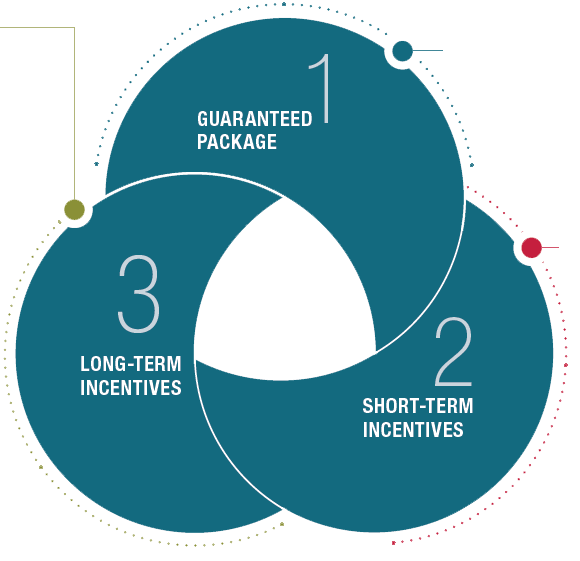
These principles are enshrined in the three main elements of remuneration:
Description and policy
Share-based remuneration plans with performance targets.
Two share-settled group plans are used, namely:
- CSP – a performance share plan;
- DBW – a portion of the bonus is deferred and used to acquire shares and the Company contributes a co-investment in the form of SARs. Both of these elements are forfeitable.
A number of cash-settled share-based remuneration plans are operated in divisions. These are explained in further detail below.
New MIPs are being introduced for senior management of Westcon International and Logicalis International in FY24.
Eligibility
Datatec Group executives and management participate in the Datatec CSP.
Executive directors and two other senior managers participate in the DBW.
Senior management of Westcon International, Logicalis International and Logicalis LATAM participate in divisional share schemes.
Cash-settled share-based remuneration plans will remain in place for the second tier of senior management in Westcon International and Logicalis International.

Description and policy
Base salary and benefits including retirement and medical scheme contributions.
Eligibility
All employees.
Description and policy
Annual bonus plan with performance targets, subject to deferral as explained below.
Eligibility
Group executives participate in an annual STI plan as explained in detail below. Management of divisions participate in STI plans similar to the Group executives but based on divisional performance targets and personal performance targets. Non-management employees typically receive lower levels of STIs based more on personal targets rather than on corporate goals.
Base salary
The purpose of the base salary is to provide a fixed income to individuals, which is subject to annual review by the Remuneration Committee. In addition to this, executive directors and senior executives are entitled to various employment benefits, such as defined contribution pension, medical insurance, and death and disability insurance. These benefits are determined by the level of base salary received by the executive.
To ensure that the base salary levels for executives are fair and competitive, the Company conducts benchmarking exercises using databases of pay levels in comparator companies provided by third-party advisors. The comparator companies used are appropriate for the role being benchmarked. As an example, the role of a regional CEO in a subsidiary division is benchmarked against subsidiaries of international groups in that region, while divisional CEOs are benchmarked against international unlisted corporations.
During these benchmarking exercises, the median pay of the comparator group is used as a guide for determining the pay of the executive concerned. These exercises are typically conducted when executive roles change or new appointments are made and when internal corporate restructuring is undertaken. However, routine annual benchmarking exercises are not carried out as the Remuneration Committee recognises the potential for driving salaries up that this could cause.
Short-term incentive
Structural overview
| Bonus formula | The STI is calculated in relation to base salary as follows: Base salary x On-Target STI percentage x [(personal score x personal weighting) + (corporate score x corporate weighting)] |
|||||||||||||
| On-target STI percentage | CEO: 175% Potential outcomes for the STI in relation to base salary are illustrated in the scenario analysis. |
|||||||||||||
| Weightings between corporate and personal performance measures | The weighting between corporate and personal performance is reflective of the participants’ seniority and the following weightings apply:
| |||||||||||||
| Target setting | Each element of the bonus is based on the achievement of a target: if that target is reached the bonus element is described as “on-target”. The Remuneration Committee establishes the target and a range around the target demarcated by “guard-rails” such that the bonus for each element is capped if the upper guard-rail is reached. Below the lower guard-rail, zero bonus is earned and at the lower guard-rail 40% of on-target bonus is earned. Between the guard-rails and the on-target position the bonus outcome is obtained by linear interpolation. The on-target bonus levels in relation to base salary are set out in the table below. STI as a percentage of base salary
Potential outcomes for the STI in relation to base salary are illustrated in the scenario analysis. The metrics used and bonus outcomes for FY23 are shown in the implementation report. |
|||||||||||||
| Delivery of the STI (applicable to executive directors and senior Group executives) | The STI is partly delivered in cash and partly delivered in shares which are deferred into the plan with minimum mandatory deferral of 20% (for STI achievement above 50% of target) and a maximum permitted deferral of 50% of STI. |
FY24 metrics
The corporate financial goals constitute 80% of the total STI for FY24. These targets include underlying earnings per share and EBITDA (with the relative weighting amended as described above). Also included are cash management/working capital targets with separate metrics for Westcon International, Logicalis International and Logicalis LATAM which match the working capital metrics included in the STI of management of the three divisions.
FY24 STI structure
| 1) Underlying earnings per share | US cents | Bonus | Target | |||
| Lower guard-rail | -12% | 40% | 35% | |||
| On target | Budget | 100% | ||||
| Upper guard-rail | 12% | 160% |
| 2) Adjusted EBITDA | USA$ million | Bonus | Target | |||
| Lower guard-rail | -14% | 40% | 30% | |||
| On target | Budget | 100% | ||||
| Upper guard-rail | 14% | 160% |
| 3a) Westcon International working capital – net working capital days | Days | Bonus | Target | |||
| Lower guard-rail | 10% | 40% | 5% | |||
| On target | Target | 100% | ||||
| Upper guard-rail | -10% | 160% |
| 3b) Logicalis International working capital – operating cash conversion | US$ million | Bonus | Target | |||
| Lower guard-rail | -20% | 40% | 5% | |||
| On target | Target | 100% | ||||
| Upper guard-rail | 20% | 160% |
| 3c) Logicalis LATAM working capital – operating cash conversion | US$ million | Bonus | Target | |||
| Lower guard-rail | -20% | 40% | 5% | |||
| On target | Target | 100% | ||||
| Upper guard-rail | 20% | 160% |
| 4) Personal KPIs – CEO and CFO | ||
| ESG – predominantly E – environmental – 10% | 20% | |
| Reduce structural discount/strategic review – 10% | ||
| Total on-target bonus | 100% |
The FY24 targets for uEPS, adjusted EBITDA and working capital metrics based on budget are not shown as this is commercially sensitive information but will be fully disclosed next year in the Implementation section of the FY24 remuneration report.
The personal KPIs agreed by the committee for the executive directors for FY24 are as follows:
- ESG – predominantly E – environmental to be assessed by achievement against the responsible business development timeline planned achievements for FY24.
- Reduce structural discount/strategic review – initiatives to achieve value generation during FY24.
Long-term incentives
Group plans - structural overview
| Deferred Bonus Warrants | Conditional Share Plan | |||
| Instrument | The deferred STI is in the form of shares which will be held in escrow for the benefit of participants. The Company co-investment is awarded as SARs. The SARs will be awarded at market value using the same price applicable to purchase the deferred shares. | Conditional rights to shares subject to performance vesting conditions. | ||
| Eligibility | Executive directors (CEO and CFO) and two senior Group executives, provided the minimum STI levels are achieved as indicated above. | Executive directors, Group executives and staff. | ||
| Allocation levels |
The mandatory deferral percentage in the DBW (if the bonus exceeds 50% of target) is 20%. The maximum deferral percentage is 50%. The number of SARs to be awarded is based on an actuarial calculation of their value relative to the current share price. |
The quantum of awards is based on annual base salary and the face value of awards which is the current Datatec share price (using a 30-day volume-weighted average price) as follows:
|
||
| Vesting period | Three years. | |||
| Additional holding period |
A holding period of two additional years will follow the vesting period of three years for the share element. The SARs are subject to a four-year exercise period commencing on the vesting date and will be subject to a two-year holding period post vesting. |
|||
| Performance period | One year, aligned with the STI performance as explained above. | Three years. | ||
| Performance conditions | No performance conditions apply, but performance is an entry qualification requirement. Further performance alignment via share price appreciation before the SARs will be exercisable. | Performance conditions apply to the grants. At the end of the three-year performance period the performance conditions are tested and if met, awards are share-settled, vesting on a sliding scale between 50% at threshold and 100% at the upper target. | ||
| Dividends | Dividends will accrue on the shares purchased by participants using their STI and these dividends must be taken in the form of shares (provided the Company offers a scrip alternative) while the shares are held in escrow to the end of the holding period. No dividends will accrue on the SARs during the exercise period. |
No dividends accrue on the CSP awards during the three-year performance period. | ||
| Plan and individual limits | The new DBW will be non-dilutive to shareholders as it will be settled by purchasing shares on the market. |
The maximum number of new shares which can be issued to participants to settle obligations under the CSP is 7.4 million shares. The maximum number of shares which can be delivered to any individual participant in the CSP is 3.7 million shares. It is proposed to increase this limit to 6.0 million shares to adjust it in proportion to modifications made to the CSP to account for special dividends. |
||
| Deferred Bonus Warrants | Conditional Share Plan | |||
| Termination of employment provisions | ||||
| Termination is at the Company's instigation and not for fault ("good leaver") | The executive will retain all the shares which he had deferred into the DBW and will retain a portion of the SARs which have been granted but not yet vested. The proportion will be determined pro rata, relative to the time of the vesting period which has elapsed up to the termination date. The terminated executive will continue to hold the reduced number of awards until the vesting date when they will vest along with the other grants in accordance with the rules of the scheme and be exercised within one year. SARs which have vested but not been exercised at the termination date must be exercised within one year thereof. | The executive will retain a portion of LTI share incentive awards which have been granted but not yet vested. The proportion will be determined pro rata, relative to the time of the vesting period which has elapsed up to the termination date. The terminated executive will continue to hold the reduced number of awards until the vesting date when they will vest in accordance with the rules of the scheme if the relevant performance conditions are satisfied. | ||
| Resignation from the Company or termination for fault | All unvested (deferred shares and SARs) and vested but unexercised SARs are forfeited. In addition, such executives will be required to repay all dividends (pre-tax value) earned from the award date on the shares. | All unvested CSP awards are forfeited. | ||
CSP performance condition for FY24
The committee intends to apply a single performance condition to the May 2023 (FY24) CSP grant, being the absolute TSR performance condition (the same performance condition as FY23) using an updated weighted average cost of capital ("WACC") as the threshold:
|
Condition |
Absolute TSR |
||
|
Performance period |
From the FY23 results announcement day being 23 May 2023 until the day of the FY26 results announcement approximately three years later. |
||
|
Threshold (50% vesting) |
11.2% compound annual growth rate ("CAGR") - the Group's WACC |
||
|
Maximum (100% vesting) |
13.2% CAGR - the WACC plus 2% |
Linear vesting applies between threshold and target levels. Potential outcomes for LTI in relation to base salary are illustrated in the scenario analysis.
The committee considers a single performance condition to be appropriate given the Group's strategic review which prioritises value creation/realisation as the overriding objective.
Divisional long-term incentives
The Group's divisions operate share-based incentive schemes to incentivise management to generate value in the divisional entities.
- Westcon International
- Following the sale of Westcon Americas in 2017, Westcon International implemented an EAP for key senior management and a SARs scheme for the next tier of senior management. Both schemes commenced at the start of FY19 with a long stop crystallisation in March 2024 determined by the valuation of Westcon International at 28 February 2023. Datatec executive directors participated in the Westcon International EAP, under the terms of certain modifications, and the outcome of this scheme is covered in the Implementation section of this report below.
- In FY24, Westcon International will implement a management incentive plan termed the Westcon International Long-Term Incentive Plan ("WILTIP"). Senior management will roll part of their gains from the Westcon International EAP into the WILTIP. In addition, a new SAR scheme similar to the original SAR scheme above will be initiated for the next tier of senior management.
- Logicalis International
- In FY24, Logicalis International implemented a management incentive plan termed the Logicalis International Long-Term Incentive Plan ("LILTIP") for the senior management team. The existing Logicalis International SAR scheme for the next tier of senior management will continue.
- Logicalis Latin America
- Logicalis LATAM operates a CSP for senior management and a SAR scheme for the next tier of senior managers. The feasibility of introducing a MIP is currently being investigated.
The CSP and SAR schemes in the divisions are cash-settled and are based on the divisional entity's valuation/notional share price. Datatec shares are not used in the settlement of the subsidiary share schemes. These schemes are accounted for under IFRS 2. Details of the operation of the subsidiary division share schemes, including grants, exercises and lapses during FY23 and the prior year, are included in Note 2 to the consolidated annual financial statements.
The WILTIP and LILTIP are not share-based payment schemes as defined under IFRS 2. The management teams of the businesses are minority shareholders in Westcon International and Logicalis International respectively and can only be realised at the same time as a value realisation/exit date for Datatec.
Management incentive plans implemented in subsidiaries: Logicalis International Long-Term Incentive Plan and Westcon International Long-Term Incentive Plan
During FY23, Datatec engaged a leading corporate advisory firm to develop an effective executive long-term incentive scheme to better align divisional executive management remuneration with Datatec shareholders. A management incentive plan focused on maximising shareholder value, designed to achieve strong equity value creation alignment and engage key management in the business as shareholders with their own money invested alongside Datatec, in the division was developed. Divisional leadership teams will be able to invest in their business at fair value in the form of "sweet equity". An intermediate holding company is required which will result in Datatec holding both a fixed return instrument (loan note) in the division and ordinary equity and management will hold a minority equity participation.
These new management incentive plans will be implemented in early FY24 for Logicalis International and Westcon International. The divisional management teams will only realise their investment at the same time as Datatec does through a value realisation event.
The executive directors of Datatec will not participate in these new divisional schemes.
Exceptional incentive awards
In addition to the three elements of remuneration noted above (base salary, short-term and long-term incentives) the Remuneration Committee may, in highly exceptional circumstances, award bonuses to management for the successful execution of significant disposal transactions which generate exceptional value for shareholders. In such rare circumstances the committee would consult with shareholders in advance of making such awards.
Scenario analysis
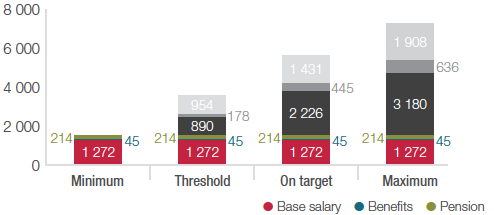
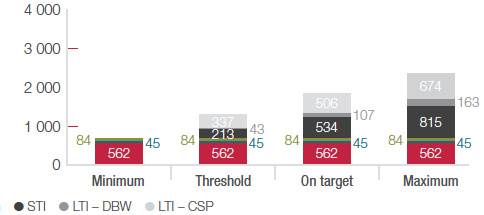
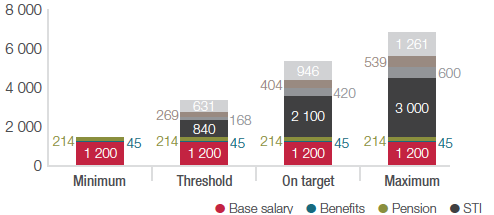
The following tables show the minimum, threshold, on-target and maximum remuneration the executive directors can earn under the remuneration policy in the next financial year, FY24, compared to FY23. The actual remuneration earned in FY23 is shown in Part 3 of this report - Implementation.
CEO - FY24US$'000
CFO - FY24US$'000
CEO - FY23US$'000
CFO - FY23US$'000
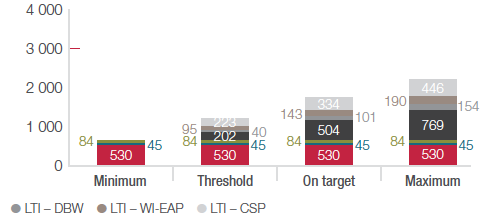
Under the minimum scenario the executives earn only their guaranteed package of base salary, benefits and Company pension contributions. All STI metrics are assumed to be below the lower guard-rail resulting in no STI payment and consequently no DBW deferral being possible. The CSP performance conditions are assumed to have not been met, resulting in no LTI value.
The threshold scenario includes the guaranteed package plus the minimum STI which would be earned if all STI metrics were triggered at the lower guard-rail threshold and 40% of on-target bonus was earned. It assumes that 20% of the bonus would be deferred into the DBW (despite investment in the DBW not being mandatory below the 50% bonus level) with the corporate co-investment applied. Under this scenario it is assumed that the CSP performance conditions are triggered three years after grant only at threshold level resulting in 50% vesting.
The on-target scenario assumes the achievement of STI targets and it assumes the mandatory minimum deferral of 20% of STI into the DBW with the corporate co-investment applied. In addition, the CSP award is assumed to vest 75% (half-way between the threshold and maximum scenarios).
The maximum scenario assumes that all STI metrics are over-achieved above the upper guard-rail resulting in the maximum STI being earned (which is 143% of the on-target STI for the CEO and 153% of the on-target STI for the CFO). This scenario also assumes the mandatory minimum deferral of 20% of STI into the DBW with the corporate co-investment applied. For the CSP, the assumption is that all performance conditions are met at target level resulting in 100% vesting of the conditional share awards (there is no "over-performance" provision in the CSP).
The mandatory minimum deferral of 20% of STI into the DBW is assumed in each scenario above (except the minimum scenario in which there is no STI). If the maximum deferral of 50% of STI were to be made into the DBW, the on-target scenario total for the CEO would increase by US$668 000 to US$6 301 000 and the on-target scenario total for the CFO would increase by US$160 000 to US$1 997 000.
It should be noted that the CSP and DBW components of the scenario analysis will only become available to the executives three and five years respectively after the financial year shown in the analysis. The LTI values shown in the above analysis are based on the share price at the date of grant and no discounting for the time value of money has been applied.
The annual grant of Datatec CSP conditional shares for the Datatec executives who participated in the Westcon International EAP was reduced by an "equivalence" factor to avoid "double dipping" in relation to reward opportunities during the life of the EAP. The equivalence factor was 29.9% for the June 2022 CSP grant in the FY23 figures above. This reduction in the annual CSP grants was to take into account the potential benefit of the once-off Westcon International EAP grant in FY19 and consequently the potential benefit arising from the Westcon International EAP was illustrated in the scenario tables using the element of the CSP grant foregone by the CEO and CFO as a proxy for the notional increase in the value of the Westcon International EAP units, even though the one-off grant of Westcon International EAP units was in FY19 before the years shown in the analysis. This adjustment has now ceased and thus is not reflected in the FY24 tables above.
Shareholding guidelines
The Board has set out shareholding guidelines for executive directors whereby a shareholding with a market value of twice annual base salary should be held. The LTIs are intended to enable new executive directors to achieve this shareholding guideline over time. Both executive directors' shareholdings are compliant with this guidance at 28 February 2023 and at the date of this report.
Directors' service contracts
The employment contracts of executive directors are terminable at six months' notice by either party and contain contractual provisions for payment on termination covering the guaranteed package but no commitment relating to STI. The termination rules applicable to the LTIs are disclosed in the LTI section above.
All non-executive directors have letters of appointment with Datatec Limited. Under these contracts, non-executive directors retire in accordance with the Memorandum of Incorporation of the Company, which is at least every three years. Retiring directors may offer themselves for re-election.
Malus and clawback policy
The Board instituted a malus and clawback policy with effect from 1 March 2020 which was subsequently revised during FY23. The policy is based on a range of possible triggers as follows:
- Material restatement of the Company's financial results caused by material non-compliance with financial reporting requirements including fraud, wilful negligence and misrepresentation
- Errors in the calculation of STI or LTI
- Material failure of risk management
- Action or conduct of a participant which, in the reasonable opinion of the Board, amounts to serious misconduct or gross negligence
- Fraud or action or conduct of a participant which, in the reasonable opinion of the Board, amounts to serious dishonesty or breach of trust
As the restatement of annual financial statements is a published event, the first trigger of the malus and clawback policy is well-defined and the process of clawing back STI and LTI which had been based on the annual financial statements before restatement will be transparent. Similarly, the calculation of STI and LTI is explained in this remuneration report annually so errors should be readily identified and would be transparently corrected under the policy.
The other triggers noted above account for eventualities other than those which cause a restatement of annual financial statements which could inflict reputational damage on the Company. The committee believes it would be the Board's fiduciary responsibility to address such matters and incorporating them into the malus and clawback policy will facilitate appropriate measures to be taken in the event of the Company suffering reputational damage through the fault of executives.
Discretion
The remuneration policy set out in this Part 2 of the remuneration report sets out the methodology, metrics and principles which will be used to determine the remuneration of Datatec directors and executives. It is not intended that there should be any departure from the policy in FY24.
However, the Remuneration Committee notes that exceptional circumstances can arise which make it expedient for the committee to retain the ability to exercise discretion in responding to exceptional situations. It also notes that the STI is discretionary and the Board may exercise its fiduciary duty to override the outcome of the financial and personal metrics in exceptional circumstances of malfeasance by an executive - see Malus and clawback policy above.
If the committee's exercising of discretion necessitates any departure from the policy, such an occurrence would be reported in future implementation reports. Any significant changes to the policy will be undertaken only after consultation with shareholders.
External appointments of executive directors
Subject to the approval of the Board, executive directors are permitted to hold a directorship in one non-Group listed company and to retain the fees payable from such an appointment.
Non-executive directors' remuneration
The fee structure for non-executive directors, including the Chair, is recommended to the Remuneration Committee by executive management. It is periodically reviewed based on benchmarking studies prepared by external advisers using data from comparable companies and taking account of the international nature of the business.
An increase in non-executive directors' annual fees of 6% is proposed for FY24. There was no increase in the previous year and the fees remained at FY22 levels in FY23. The proposed increase will be put to shareholders for approval at the AGM on 27 July 2023. The fees for FY23 are set out in the implementation report below.
The Chair's fee covers her role on the Board and its committees and attendance at subsidiary board meetings and shareholder meetings as required. Other non-executive directors receive a fee for their Board role plus fees as members/chairs of individual committees.
The terms and conditions of appointment of non-executive directors are available on request from the Company Secretary. Non-executive directors are not eligible to participate in the annual bonus plan or any of the Datatec share incentive schemes.
Part 3: Remuneration implementation
Base pay adjustments
The base salary for the executive directors was not increased for FY23, remaining at the same level as the prior year.
For FY24, the Remuneration Committee has approved an increase of 6% in the base salary for the executive directors, noting that over the past two years the increase has been below that awarded to Datatec head office staff. By comparison, over the same two-year period the US Consumer Prices Index ("CPI") increased by 14.4%.
Datatec Group short-term incentives
The FY23 STI bonus structure comprised Company and individual performance targets. The outcome is set out in the table below.
The committee assessed achievement against the personal KPI goals as follows:
For the CEO:
- ESG - during FY23 the Group expedited its Responsible Business programme to drive improvements particularly in the environmental and social aspects of ESG. The progress made is reflected in the Group's Integrated Report. Notable achievements include: EcoVadis assessment, UN Global Compact; TCFD supporter; GRI and JSE Gap Analysis; CDP reporting of all entities in the Group; Net Zero Commitment (SBTi). The committee considered that the CEO's direction and close involvement in championing responsible business merits an achievement of 12% for this KPI (target 10%).
- Leadership (operational and organisational) - the Remuneration Committee considered how the CEO has led the Group while promoting its values and Code of Conduct. This was done utilising a Culture Scorecard which allowed quantitative assessment of five components:
- Behaviour
- Proportion of employees who completed training in ethics
- Proportion of employees who completed training in cyber security
- Safety and cyber metrics
- People
- Turnover rate of direct reports/leadership team
- Employee engagement survey/employee pulse
- Behaviour
The overall assessment of the leadership category was determined to be 5.52%, above the target of 5%.
- Reduce structural discount - progress on the Strategic Review announced in August 2021 was assessed during FY23. The sale of Analysys Mason and consequent special dividend distributing US$158 million to shareholders was a significant value realisation event and the committee considered this metric to have been overachieved and awarded a 16% rating (target 10%).
For the CFO:
- ESG - the CFO's role in ESG has been to support the CEO in leading the Responsible Business process and the committee concluded an achievement of 12% for this KPI was merited (target 10%).
- Leadership (operational and organisational) - the Remuneration Committee considered how the achievement of the CEO against the Culture Scorecard metrics noted above should translate to the CFO in assessing how he has led the finance teams across the Group while promoting its values and Code of Conduct. This was assessed to be 5.44% (target 5%).
- Reduce structural discount - the committee assessed that the CFO's input on the Strategic Review has been highly effective in support of the CEO especially in relation to the Analysys Mason sale transaction and therefore the same achievement of 16% (target 10%) for this metric is merited.
FY23 bonus outcome
| 1) Underlying earnings per share | US cents | Bonus | Target | Outcome CEO |
Outcome CFO |
||||
| Actual | 7.9 | 0% | |||||||
| Lower guard-rail | 15.0 | 40% | 35% | 0.0% | 0.0% | ||||
| On target | 17.4 | 100% | |||||||
| Upper guard-rail | 19.0 | 160% | |||||||
| 2) Adjusted EBITDA | US$ million | Bonus | Target | Outcome CEO |
Outcome CFO |
||||
| Lower guard-rail | 163 | 40% | |||||||
| Actual | 188 | 97% | 30% | 29.1% | 29.1% | ||||
| On target | 190 | 100% | |||||||
| Upper guard-rail | 216 | 160% | |||||||
| Note: Budget and actual figures have been adjusted by adding Analysys Mason adjusted EBITDA in H1 | |||||||||
| 3a) Logicalis working capital – operating cash conversion | US$ million | Bonus | Target | Outcome CEO |
Outcome CFO |
||||
| Lower guard-rail | 67 | 40% | |||||||
| On target | 84 | 100% | 5% | 6.0% | 6.0% | ||||
| Actual | 101 | 120% | |||||||
| Upper guard-rail | 105 | 160% | |||||||
| 3b) Westcon working capital – net working capital days | Days | Bonus | Target | Outcome CEO |
Outcome CFO |
||||
| Lower guard-rail | 21 | 40% | 5% | 8.0% | 8.0% | ||||
| On target | 19 | 100% | |||||||
| Upper guard-rail | 17 | 160% | |||||||
| Actual | 12.1 | 160% | |||||||
| 4) Personal KPIs – CEO and CFO | Target | Outcome CEO |
Outcome CFO |
||||||
|
10% | ||||||||
|
5% | 25% | 33.5% | 33.4% | |||||
|
10% | ||||||||
| Total on-target bonus | 100% | 76.6% | 76.5% | ||||||
The achievement of the targets set out below translated into the following bonus payment for FY23. The executive directors are required to defer a mandatory minimum of 20% of their FY23 bonus into the DBW (the final STI disclosed below includes the mandatory deferral percentage). See section "Deferred Bonus Warrants to be awarded during FY24" for details.
| Executive director | Base salary (A) |
On-target bonus rate (B) |
Weighted corporate score (target 75%) (C) |
Weighted personal score (target 25%) (D) |
Final STI (A x B x (C + D)) |
|
| Jens Montanana (CEO) | 1 200 000 | 175% | 43.1% | 33.5% | 1 608 275 | |
| Ivan Dittrich (CFO) | 530 000 | 95% | 43.1% | 33.4% | 385 200 |
The targets and outcomes of the annual bonuses of the executive directors for FY23, shown as a percentage of base salary and split by the bonus elements, are illustrated below.
CEO FY23 bonus composition as a percentage of basic salary %
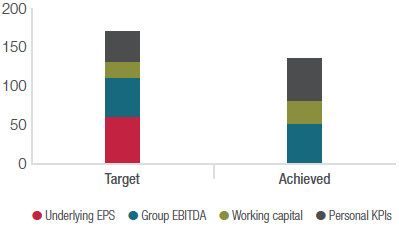
CFO FY23 bonus composition as a percentage of basic salary%

The metrics for the executive directors' STI in FY24 are set out in Part 2 of this remuneration report.
Datatec Group long-term incentives awarded during FY23
Conditional Share Plan awarded during FY23
The annual grant of CSP awards was made on 11 July 2022 following approval by the Remuneration Committee. The awards will vest after three years subject to the Group meeting certain performance conditions set by the Remuneration Committee. One performance conditions was applied to the FY23 award in line with the policy communicated in the FY22 remuneration report, namely:
| Performance condition | Threshold - 50% vesting | Maximum - 100% vesting | ||||||||||||||
|
Total Shareholder Return ("TSR") calculated as follows:
Where:
The TSR index referred to above is the 30-day vwap of a Datatec share adjusted for all dividends (ordinary, special or any other return to ordinary shareholders) which were distributed during the performance period. Such dividends will be treated as if they had been reinvested in Datatec shares on the dates paid. |
TSR must exceed 10.80% which was the Company's weighted average cost of capital as at 28 February 2022, as measured over a three-year performance period. |
TSR must equal or exceed 12.80%, as measured over a three-year performance period. |
||||||||||||||
| Linear vesting applies between threshold and maximum levels. |
Executive directors' CSP awards are as follows:
| Number of awards - movement in FY23 | Fair value of awards | ||||||||||||
| CSP | Grant date |
At 28 February 2022 |
Granted | Vested | Lapsed | Modification | At 28 February 2023 |
US$'000 | On grant as % of base pay |
On vesting US$'000 |
At 28 February 2023 US$'000 |
At 28 February 2022 US$'000 |
|
| JP Montanana | 01 Jun 19 | 612 695 | – | (153 174) | (459 521) | – | – | 1 246 | 109% | 377 | – | 372 | |
|---|---|---|---|---|---|---|---|---|---|---|---|---|---|
| 01 Jun 20 | 889 952 | – | – | – | 366 536 | 1 256 488 | 1 086 | 95% | 2 256 | 1 442 | |||
| 01 Jun 21 | 590 734 | – | – | – | 243 300 | 834 034 | 1 094 | 91% | 998 | 957 | |||
| 11 Jul 22 | – | 505 436 | – | – | 208 169 | 713 605 | 1 261 | 105% | 854 | – | |||
| 2 093 381 | 505 436 | (153 174) | (459 521) | 818 005 | 2 804 127 | 4 109 | 2 771 | ||||||
| IP Dittrich | 01 Jun 19 | 216 271 | – | (54 068) | (162 203) | – | – | 344 | 87% | 133 | – | 131 | |
| 01 Jun 20 | 314 137 | – | – | – | 129 381 | 443 518 | 383 | 76% | 796 | 509 | |||
| 01 Jun 21 | 208 726 | – | – | – | 85 966 | 294 692 | 387 | 73% | 353 | 338 | |||
| 11 Jul 22 | – | 178 588 | – | – | 73 554 | 252 142 | 446 | 84% | 302 | – | |||
| 739 134 | 178 588 | (54 068) | (162 203) | 288 901 | 990 352 | 1 451 | 978 | ||||||
The fair value of the CSP awards granted during FY23 at date of grant (11 July 2022) was R39.14 (FY22: R29.09) per award being the 30-day volume-weighted average share price on the day of the Group's FY22 results announcement. The fair value at 28 February 2023 is based on the 30-day vwap on 28 February 2023, R33.07 (FY22: R37.53) multiplied by an estimate of the performance conditions being achieved. The 2019 awards vested 25% in June 2022 with 25% vesting as the return on invested capital ("ROIC") performance condition threshold was achieved. The threshold for the uEPS performance condition was not achieved. Therefore 75% of the 2019 award lapsed.
For the 2020 awards, the fair value at 28 February 2023 assumes that the awards will vest in full as the performance condition targets are expected to be achieved. For the 2021 and 2022 awards, the fair value assumes 67% vesting of the awards, i.e. that the performance condition targets will only be 67% achieved. The actual value of any benefit received by the directors from these CSPs will be reported in future remuneration reports when the awards vest.
Modification to Conditional Share Plan during FY23
On 5 December 2022, Datatec paid a special dividend to shareholders. In order for the economic interest of participants in the CSP to be maintained, a modification to the number of awards which were in their vesting period on the payment date of the special dividend is required. The modification involves a "factor" which is calculated as follows: X/(X-Y), where X is the share price at close the day prior to ex-div date and Y is the amount of the (cash) dividend. For the special dividend paid on 5 December 2022 the factor is 4285/(4285-1250) = 1.412 and the table above shows the increase in the number of awards in accordance with this modification.
Deferred bonus awarded during FY23 based on FY22 short-term incentives outcomes
Executive directors deferred part of their FY22 bonuses under the terms of the DBW. The deferred part of the FY22 bonus was used to purchase Datatec shares ("bonus shares") which will be held in escrow until vesting. In accordance with the policy, an equal co-investment from the Company was applied to the deferred bonus amount in the form of a grant of SARs whose expected value based on an actuarial calculation is equal to the STI deferred. The number of SARs awarded was determined by the Remuneration Committee based on an estimate of the fair value of the SARs at the date of grant in relation to the market value of a Datatec share.
Bonus shares purchased and the SARs granted in terms of the DBW Plan are subject to an employment condition and only vest with the participant if they remain in employment with the Company for approximately three years to the vesting date on 30 June 2025. In addition, there is a two-year, post vesting holding period which applies to the bonus shares and any shares arising from exercise of the SARs within two years of vesting.
| Amount of bonus deferred | |||||||
| DBW | FY23 grant date |
% | US$'000 | Bonus shares purchased US$'000 |
SARs granted US$'000 |
Fair value of awards on grant US$'000 |
|
| JP Montanana | 15 Aug 22 | 24.2% | 624 | 624 | 624 | 1 248 | |
| IP Dittrich | 15 Aug 22 | 20.0% | 124 | 124 | 124 | 247 | |
The number of shares to be purchased was calculated based on the Rand value of bonus deferred divided by R39.19 being the 30-day volume-weighted average share price on 24 May 2022, the date of the Group's FY22 results announcement. The number of shares to be purchased was increased by 3.01824% being the ratio applicable to the FY22 scrip distribution paid on 18 July 2022 between the deferral of the bonus and the grant of bonus shares. These shares were acquired, with prior clearance, at a volume-weighted average price of R46.1425 per share. The bonus shares granted in terms of the DBW Plan are subject to an employment condition and only vest with the participant if they remain in employment with the Company for approximately three years to the vesting date on 30 June 2025 during which time they are held in escrow accounts for each participant. These bonus shares are included in the directors' shareholdings shown later in this report.
Under the rules of the DBW, dividends paid on the bonus shares during the vesting period must be taken as scrip distributions (if the Company provides a scrip alternative). The value of the scrip distribution received by the directors who are participants in the DBW during FY23 are as follows:
| Dividends on DBW bonus shares | FY23 US$000 |
FY22 US$000 |
|
| JP Montanana | 184 | – | |
|---|---|---|---|
| IP Dittrich | 36 | – |
SARs in respect of Datatec ordinary shares were granted in terms of the DBW Plan on 12 August 2022 with a grant price of R39.19 per SAR being the 30-day volume-weighted average share price on 24 May 2022, the date of the Group's FY22 results announcement. The SARs granted to the directors were as follows:
| Number of awards - movement in FY23 | Fair value of awards | ||||||||||
| DBW SARS | Grant date |
At 28 February 2022 |
Granted | Vested | Lapsed | Modification | At 28 February 2023 |
On grant US$'000 |
At 28 February 2023 US$'000 |
At 28 February 2022 US$'000 |
|
| JP Montanana | 15 Aug 22 | 1 000 000 | 411 860 | 1 411 860 | 624 | 408 | – | ||||
|---|---|---|---|---|---|---|---|---|---|---|---|
| IP Dittrich | 15 Aug 22 | 198 108 | 81 593 | 279 701 | 124 | 81 | – | ||||
Modification to Deferred Bonus Warrant share appreciation rights during FY23
The DBW SARS require a modification to the number of awards in the same way as the CSP units outstanding at the time of the special dividend as described above. In addition, the SAR strike price requires to be reduced by the same modification factor of 1.412 which results in the strike price of R39.19 being modified to R27.75. The table above shows the increase in the number of awards in accordance with the modification and the fair value is calculated using the 30-day vwap price at 28 February 2023 less the modified strike price.
Deferred Bonus Warrants to be awarded during FY24 based on the FY23 short-term incentive outcomes
Executive directors have deferred part of their FY23 bonuses under the terms of the DBW. In accordance with the policy, an equal co-investment from the Company will be applied to the deferred bonus amount in the form of a grant of SARs whose expected value based on an actuarial calculation is equal to the STI deferred.
| Amount of bonus deferred | |||||||
| DBW | FY24 grant date (expected) |
% | US$'000 | Datatec shares to be purchased US$'000 |
SARs to be granted US$'000 |
Fair value of awards on grant US$'000 |
|
| JP Montanana | Jun 23 | 29.4% | 473 | 473 | 473 | 946 | |
| IP Dittrich | Jun 23 | 22.1% | 85 | 85 | 85 | 170 | |
The table above shows the monetary amount of the FY23 STI deferral to be used to purchase Datatec shares and Company co-investment in a grant of SARs to be made in June 2023. The fair value of the awards on grant includes both the shares purchased by directors with part of their FY23 bonus and the Company co-investment in the form of a grant of SARs.
Previous Datatec Group share schemes
Two Datatec Group share schemes which operated in the past and were winding down during FY23 are the DBP and the SARs scheme.
The previous Datatec Group share schemes, the SARS, long-term incentive plan and old DBP, operated from 2005 until 2017 and thereafter they were superseded by the CSP and new DBP which was itself succeeded by the DBW. Existing grants under the previous share schemes remained active for the three-year performance periods and details of the operation of the previous share schemes have been provided in past remuneration reports. The only remaining vested SARs award at 28 February 2022 was the SARs granted in May 2015 (during FY16) which had vested during FY19 and the CEO was the only director holding this award. This last remaining SAR award was exercised during FY23 on 1 July 2022 at an exercise price of ZAR 43.01 which was ZAR11.52 above the strike price of ZAR31.49.
Deferred Bonus Plan
The DBP was discontinued in FY22 after executive directors deferred part of their FY21 bonuses under the terms of the DBP in June 2021. In accordance with the policy, a co-investment equal to the amount of deferred bonus was provided by the Company and the total amount was applied to purchase Datatec shares in accordance with the policy.
Executive directors' holdings in the DBP are shown in the table below:
| Amount of bonus deferred | |||||||||||
| DBP | Bonus year |
Grant date |
% | US$'000 | Company co- investment US$'000 |
Total invested in shares US$'000 |
Total number of shares purchased |
Fair value of awards on grant US$'000 |
Fair value of awards at 28 February 2023 US$'000 |
Fair value of awards at 28 February 2022 US$'000 |
|
| JP Montanana | FY19 | Jun 19 | 50.0% | 812 | 812 | 1 624 | 702 407 | 1 624 | n/a | 1 707 | |
| FY20 | Jun 20 | 37.3% | 300 | 300 | 600 | 432 353 | 600 | 776 | 1 050 | ||
|---|---|---|---|---|---|---|---|---|---|---|---|
| FY21 | Jun 21 | 37.9% | 1 039 | 1 039 | 2 078 | 987 024 | 2 078 | 1 772 | 2 398 | ||
| Forfeitable total at 28 February 2023 | 1 419 377 | 2 678 | 2 548 | 5 155 | |||||||
| IP Dittrich | FY19 | Jun 19 | 25.0% | 96 | 96 | 191 | 82 636 | 191 | n/a | 201 | |
| FY20 | Jun 20 | 25.0% | 48 | 48 | 96 | 69 317 | 96 | 124 | 168 | ||
| FY21 | Jun 21 | 33.3% | 225 | 225 | 450 | 213 778 | 450 | 384 | 519 | ||
| Forfeitable total at 28 February 2023 | 283 095 | 546 | 508 | 889 | |||||||
| 1 702 472 | 3 224 | 3 056 | 6 044 | ||||||||
All the DBP shares are forfeitable if the director resigns from Datatec during the three-year vesting period. The fair value of these awards at date of grant was the share price at which the DBP shares were purchased on the dates shown in the table. The fair value as at 28 February 2023 is R33.07 (FY22: R37.53) being the 30-day volume-weighted average share price on 28 February 2023.
During FY23, the DBP awards from June 2019 vested at the end of the three-year employment period. These awards are not included in the fair value total at 28 February 2023 because they no longer form part of the DBP.
The forfeitable DBP shares above are included in the directors' shareholdings as at 28 February 2023 disclosed later in this report.
The value of dividends directors received in FY23 on DBP shares while they were in the vesting period was:
| Dividends | FY23 US$'000 |
FY22 US$'000 |
|
| JP Montanana | 1 014 | 464 | |
|---|---|---|---|
| IP Dittrich | 202 | 62 |
Dividends received on DBP shares while they are in the vesting period would be repayable to the Company if the shares to which the dividends relate are forfeit prior to vesting due to breach of the employment condition.
Share Appreciation Rights Scheme
The only remaining vested SARs award at 28 February 2022 was the SARs granted in May 2015 (during FY16) which had vested during FY19 and the CEO was the only director holding this award. The last remaining SAR award was exercise during FY23 on 1 July 2022 at an exercise price of ZAR43.01 which was ZAR11.52 above the strike price of ZAR31.49.
Directors' interests in Westcon International Equity Appreciation Plan (awarded during FY19)
The Remuneration Committee implemented an EAP for Westcon International senior management to incentivise value generation from the starting point of 1 March 2018 after the disposal of Westcon Americas in the SYNNEX transaction. Participants were awarded a once-off grant of "units", whose value will be linked to the value of Westcon International; this is a notional base value which was estimated to be US$125 million (the "hurdle"). The units do not have any share rights, in particular they do not have the right to dividends or votes.
10% of the value of Westcon International above the hurdle would be paid to the EAP pool in the event of a sale of Westcon International. Each unit will receive a pro rata share of the EAP pool when Westcon International is sold. For example, if Westcon International is sold for US$300 million, the EAP pool will be US$17.5 million: ((US$300 million - US$125 million) x 10%). If there are 100 000 units in issue, each unit will be worth US$175. During FY21, Datatec recapitalised Westcon International by converting US$80 million of inter-company loans to equity investment. This capitalisation has been adjusted for in computing the equity appreciation for participants at the end of the EAP.
If Westcon International was not sold within five years of the start of the scheme on 1 March 2018, the rules of the EAP provided that the business will be valued by an independent valuer at 1 March 2023 and the EAP would pay out to participants on the basis of that valuation. The valuation has been undertaken using a methodology which is fair and reasonable to all stakeholders including Datatec shareholders and participants in the EAP taking account of the recapitalisation noted above. Datatec executive directors received one-off awards under the Westcon International EAP in FY19 by virtue of their leadership roles as CEO and CFO of Westcon International (in addition to their Datatec roles).
The annual grant of Datatec CSP conditional shares for the Datatec executives who participated in the Westcon International EAP has been reduced by an "equivalence" factor to avoid double participation in relation to reward opportunities over the five-year life of the Westcon International EAP.
In addition, for the Datatec executives who participate in the Westcon International EAP an adjustment of 10% carried interest (CAGR) was added to the equity base of US$125 million. This annually increasing threshold was used for the equivalence factor calculation described above.
Further, the committee determined that there will be a financial cap on the benefit the CEO and CFO can receive from their participation in the Westcon International EAP. The cap was based on the pay-out which would be achieved if the Westcon International business is valued at/sold for US$400 million. The level of the cap is:
- CEO: US$6.6 million
- CFO: US$3.3 million
The valuation of Westcon International at 1 March 2023 was US$488.44 million which results in the fair value of the EAP units held by Datatec executives being calculated as follows:
Threshold: US$125 x 10% pa CAGR = US$201
Equity appreciation per unit: US$488.44 - US$201.31 = US$287.12
At this valuation, the financial cap noted above comes into effect and the payment due to the Datatec executives is restricted to the capped amount.
| Westcon EAP | Grant date (FY19) |
Number of awards |
Fair value of awards on grant US$'000 |
Grant fair value as % of base pay % |
Fair value of awards at 28 February 2023 |
Fair value of awards at 28 February 2022 US$'000 |
||
| Pre-cap US$'000 |
Capped US$'000 |
|||||||
| JP Montanana | 14 Mar 18 | 30 000 | – | – | 8 614 | 6 600 | 2 605 | |
|---|---|---|---|---|---|---|---|---|
| IP Dittrich | 14 Mar 18 | 15 000 | – | – | 4 307 | 3 300 | 1 302 | |
In addition to the above, Datatec granted Mr Montanana a conditional award equivalent to 10 000 Westcon International EAP units on 14 March 2018. This award was conditional on a sale of Westcon International for US$300 million or more. If that condition had been met, Mr Montanana would receive a cash payment from Datatec equivalent to the value of 10 000 units of the Westcon International EAP. The award had the same adjustment made to the threshold, 10% carried interest (CAGR) annually added to the equity base of US$125 million, as the other Westcon International EAP awards provided to Datatec executives. As Westcon International had not been sold by 14 March 2023, this award has lapsed.
Dilution attributable to Datatec Group share incentive plans
In practice, the Company has not issued new shares in settlement of share schemes in the recent past and has no intention to do so in the near future. Instead, shares for settlement of share schemes are purchased in the market.
If new shares were to be issued to settle expected vesting of outstanding CSP awards, the dilution arising would be 2.88% (FY22: 1.63%).
The DBP does not give rise to any dilution effect because forfeitable shares are granted to participants at the start of the holding period and settled using shares purchased in the market. However, the forfeitable shares are treated as treasury shares until vesting. The DBW does not give rise to any dilution effect because forfeitable shares are granted to participants at the start of the holding period using shares purchased in the market and the SARs co-investment, when ultimately exercised, will also use shares purchased in the market at the time.
None of the divisional share-based remuneration plans has any dilution effect as they are not settled with Datatec shares.
Shareholding guidelines
Both executive directors are compliant with the shareholding guidelines set out in the Policy section at the date of this report.
Single figure remuneration of executive directors
The following tables show the composition of a single figure of remuneration for the executive directors:
| CEO | CFO | |||||
| Component | FY23 US$'000 |
FY22 US$'000 |
FY23 US$'000 |
FY22 US$'000 |
||
| LTI | CSP | 2 256 | 372 | 797 | 131 | |
|---|---|---|---|---|---|---|
| WI EAP | 6 600 | – | 3 300 | – | ||
| Total LTI | 8 856 | 372 | 4 097 | 131 | ||
| STI | Cash | 1 136 | 1 953 | 300 | 494 | |
| Deferred | 473 | 624 | 85 | 124 | ||
| Total STI | 1 609 | 2 577 | 385 | 618 | ||
| Pension | 214 | 214 | 84 | 84 | ||
| Benefits | 49 | 59 | 50 | 49 | ||
| Base salary | 1 200 | 1 200 | 530 | 530 | ||
| Guaranteed package | 1 463 | 1 473 | 664 | 663 | ||
| 11 928 | 4 422 | 5 146 | 1 412 | |||
LTI
CSP
The remuneration from the CSP shown for FY23 is the fair value of the award expected to vest because the performance conditions for the June 2020 CSP grant are expected to be met. The CSP remuneration shown for FY22 arises from the vesting of 25% of the June 2019 CSP in June 2022 following achievement of the ROIC threshold. Fair value is calculated using the 30-day vwap of Datatec shares as at 28 February in each year.
DBW
The value of the SARs granted by the Company in respect of FY23 and FY22 bonuses deferred by the directors is not included in the single figure remuneration table. The intrinsic value of these SARs will be reported in the single figure remuneration table for the financial year preceding their vesting.
Westcon International EAP
The value of the payment to the executive directors due in FY24 from the crystallisation of the Westcon International EAP based on the valuation of Westcon International at 28 February 2023 is included in their FY23 LTI in the single figure remuneration table.
STI
The STI shown above is split between the element deferred into the DBW and the element paid in cash after publication of the Group results.
Non-executive executive directors' remuneration
During FY23, non-executive directors received the following fees which were at the same level as FY22:
| Role | FY23 fee US$ |
|
| Chair of the Board (total fee inclusive of all committee and subsidiary board work) | 211 640 | |
|---|---|---|
| Senior non-executive director | 78 000 | |
| Non-executive director | 66 860 | |
| Chair of the Audit, Risk and Compliance Committee | 33 420 | |
| Member of the Audit, Risk and Compliance Committee | 16 710 | |
| Chair of the Social and Ethics Committee | 11 140 | |
| Member of the Social and Ethics Committee | 5 570 | |
| Chair of the Remuneration Committee | 16 710 | |
| Member of the Remuneration Committee | 8 360 | |
| Member of the Nominations Committee | 5 570 | |
| Chair of Datatec Technology and Education Foundation | 12 600 |
These fees were approved by shareholders at the AGM on 27 July 2022. An increase of 6% is proposed for FY24 (the year ending 28 February 2024) and the proposed fees for FY24 will be submitted to the 2023 AGM for shareholder approval.
Non-executive directors are reimbursed for travel costs necessary for attending Board meetings and do not receive any employment benefits.
Summary of directors' remuneration
The remuneration of directors serving on the Board in FY23 and FY22 is shown in the following tables:
| FY23 | ||||||||
| Guaranteed package | ||||||||
| US$'000 | Basic salary |
Pension | Other benefits |
Fees | STI | LTI | Total | |
| Executive directors | ||||||||
| JP Montanana | 1 200 | 214 | 49 | – | 1 609 | 8 856 | 11 928 | |
| IP Dittrich | 530 | 84 | 50 | – | 385 | 4 097 | 5 146 | |
| Total executive directors | 1 730 | 298 | 99 | – | 1 994 | 12 953 | 17 074 | |
| Non-executive directors | ||||||||
| M Makanjee | – | – | – | 224 | – | – | 224 | |
| SJ Davidson | – | – | – | 100 | – | – | 100 | |
| JF McCartney | – | – | – | 72 | – | – | 72 | |
| CRK Medlock | – | – | – | 84 | – | – | 84 | |
| MJN Njeke | – | – | – | 114 | – | – | 114 | |
| LC Rapparini* | – | – | – | 138 | – | – | 138 | |
| E Singh-Bushell - to 27 July 2022 | – | – | – | 45 | – | – | 45 | |
| DS Sita | – | – | – | 86 | – | – | 86 | |
| Total non-executive directors | – | – | – | 863 | – | – | 863 | |
| Total directors' emoluments | 1 730 | 298 | 99 | 863 | 1 994 | 12 953 | 17 937 | |
| * Note: LC Rapparini's fees include: | ||||||||
| Datatec non-executive director fees from appointment on 1 September 2022 | 36 | |||||||
| Logicalis LATAM ARCC Chair and committee fees throughout FY23 | 102 | |||||||
| 138 | ||||||||
| FY22 | |||||||||
| Guaranteed package | |||||||||
| US$'000 | Basic salary | Pension | Other benefits |
Fees | STI | LTI | Total | ||
| Executive directors | |||||||||
| JP Montanana | 1 200 | 214 | 59 | – | 2 577 | 372 | 4 422 | ||
| IP Dittrich | 530 | 84 | 49 | – | 618 | 131 | 1 412 | ||
| Total executive directors | 1 730 | 298 | 108 | – | 3 195 | 503 | 5 834 | ||
| Non-executive directors | |||||||||
| SJ Davidson | – | – | – | 212 | – | – | 212 | ||
| M Makanjee | – | – | – | 111 | – | – | 111 | ||
| JF McCartney | – | – | – | 72 | – | – | 72 | ||
| CRK Medlock | – | – | – | 84 | – | – | 84 | ||
| MJN Njeke | – | – | – | 114 | – | – | 114 | ||
| E Singh-Bushell | – | – | – | 109 | – | – | 109 | ||
| Total non-executive directors | – | – | – | 702 | – | – | 702 | ||
| Total directors' emoluments | 1 730 | 298 | 108 | 702 | 3 195 | 503 | 6 536 | ||
Note: The non-executive directors' fees shown above exclude VAT.