


Datatec social investment report
The bedrock of any prosperous country comes from the quality of education it provides to its people. South Africa relies on a collective effort of private, public, and non-profit organisations ("NPOs") to ensure efforts are made to elevate the standard of education and increase access for its citizens to meet the urgent need of skills shortage and address the woes of unemployment. Datatec has been an active contributor in ensuring efforts are focused primarily on improving the quality of education and creating opportunities for those less fortunate through the Datatec Educational and Technology Foundation ("the Foundation").
OVERVIEW OF THE FOUNDATION
The Foundation funds educational organisations to improve education within underprivileged communities in South Africa, specifically in science, technology, engineering and mathematics ("STEM") subjects.
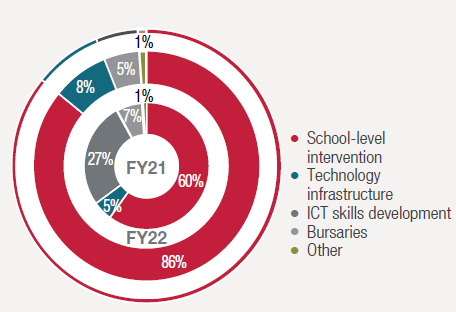
Datatec's CSI spend is directed at educational initiatives consisting of school-level intervention programmes for learners and teachers and educational bursaries. Other initiatives include providing technology infrastructure, tertiary ICT education and skills development for unemployed youth.
OUR PROGRAMMES
Kutlwanong Promaths
Kutlwanong's Promaths learner programme provides additional mathematics and science tuition to Grade 10, 11 and 12 township learners. In FY22, the Foundation supported 240 learners in Promaths' Eastern Cape Mdantsane centre. The centre supports students from rural and township schools in the area. The Foundation partnered with Promaths more than a decade ago to establish the Mdantsane centre and continues to be the principal funder for the project in this region. Promaths also focuses on upskilling teachers by providing teaching aids to help educators deliver lessons in a more engaging, memorable way. The programme's content is aligned with the National Department of Education's curriculum. Thus, learners can practice in a highly relevant, appropriate manner.
OLICO Maths Education
OLICO provides a blended use of extracurricular mathematics tutoring and custom-built online mathematics programmes for Grade 7 to 9 learners, alongside mathematics clubs aimed at primary-school learners (Grades R – 6). The mathematics clubs offer fun mathematics games and activities to build essential core number fluency and enjoyment of the subjects. The class of 2021 represents OLICO's best matric results to date with a 100% mathematics pass rate and 100% Bachelor level pass rate. OLICO is trying to grow its reach in the township and aims to increase its matric cohort to approximately 300 learners over the next two years. With the assistance of the Foundation, the computer lab of Realogile High School was expanded in FY21. The Foundation funds the programme director's annual salary and contributes to the school's mathematics programme.
Tomorrow Trust
The Tomorrow Trust is an NPO that provides integrated academic and psychosocial support to orphaned and vulnerable children. Datatec supports the Saturday and holiday school programme, which provides academic support for children from disadvantaged backgrounds. Learners receive comprehensive academic lessons in mathematics, English and natural science. Career guidance support, leadership workshops and psychosocial support are also provided. The organisation, which works in townships across Gauteng and the Western Cape, also runs the Shift Initiative, which equips learners to meet some of the challenges associated explicitly with the Fourth Industrial Revolution. These include digitised tuition in digital literacy, coding, gaming and robotics. In FY22, the Foundation supported 30 Grade 10 learners and 30 Grade 12 learners, and 100% of Datatec-supported learners achieved higher results than their peers at school in mathematics. The 2021 matric cohort achieved 27 distinctions.

Tomorrow Trust Grade 12 Learners
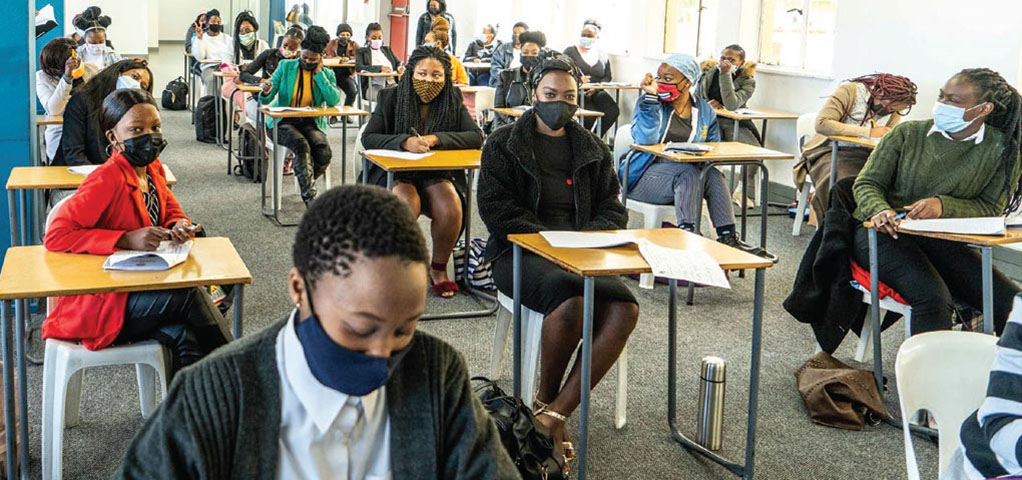
Maharishi campus
Maharishi Institute
The Maharishi Institute offers virtually free university access opportunities to unemployed youth, employable after completing their degree courses. Using its core ideology of consciousness-based education to develop the potential of every student, the non-profit private college and self-development organisation in Johannesburg and Cape Town provides bursaries and self-development programmes for bright, deserving youth to further their studies. The institute assists them in finding employment opportunities when they graduate. The qualifications that they offer are accredited through various SETAs in South Africa. Maharishi's online systems have been implemented for students to work seamlessly off and on campus and WiFi is accessible across the campus.
Belgium Campus iTversity
Belgium Campus is a pioneering iTversity in South Africa that helps raise the bar in private education through its graduates in the ICT industry. Courses offered include a Bachelor of Computing and a Bachelor of Information Technology. Two of the three students from previously disadvantaged communities in the Bachelor's programme funded by the Foundation have progressed to the fourth year of their studies.
The Vula Programme at Hilton College
The Vula Programme, based in KwaZulu-Natal, is a beneficiary project of the Foundation. It was established in 2001 by the Hiltonian Society, which owns Hilton College, to fund NPOs providing professional development to teachers and organisations at the secondary-school level. The programme is focused on improving results in mathematics, science and English. The programme interacts with teachers from eight of the 13 educational districts in KwaZulu-Natal to help to improve the teaching of mathematics and physical science. The Foundation sponsored 103 teachers who attended two-week workshops in the second half of 2021, while 235 teachers from previous intakes were supported and supplied with learning materials.
Afrika Tikkun
Afrika Tikkun aims to reduce unemployment by empowering young people in the context of family and is a well-known NPO throughout South Africa. Their focus is on education, personal development, nutrition, health, family support, skills development and work placement. Core programmes include early childhood development, child and youth development, and career development. Student programmes encompass primary health care, family support, nutrition and food, and empowerment. In FY22, 100 iPads were purchased by the Foundation to support the eLearning programme for the Youth Development Programme. The iPads were distributed across five Afrika Tikkun centres, enabling access to quality infrastructure for learners.
Educational organisations continue to use blended learning to overcome Covid-19 challenges.
Over the last two years, the Covid-19 pandemic and the strict lockdown regulations in South Africa disrupted learning from preschool to secondary school. The education sector established new policies and regulations, including academic timetable adjustments and new instructional programs. These changes to academic years have necessitated learners to stay home for extended periods or attend classes on a rotational basis. To continue to meet the demands of blended learning, the Foundation continued to fund educational organisations to integrate technology into the education space. The Foundation's beneficiary organisations continued providing teaching, development, and care that learners needed to achieve their remarkable results.
Some of the FY22 highlights:
- Kutlwanong Promaths continued to utilise online platforms adopted in FY21 to deliver blended learning
- WhatsApp hotline catered for 10 000 learners and OLICO's data costs were zero-rated with the major Telco providers
- Tomorrow Trust continued to provide their SHIFT Programme – it houses all their integrated digital programmes such as coding, robotics, digital literacy workshop, and online learning. During this period, each learner received 40GB of data to connect to online classes
- Maharishi established a Digital Youth Academy with approval for three further national SETA accreditations and 40 international certifications
- Afrika Tikkun purchased the "My Learning Hub" platform, a learner management system to offer programmes through a blended learning approach. Uploading of educational content is ongoing and continues to be adapted to incorporate a more South African curriculum. They were able to digitise content for a number of their programmes
CSI SPEND BY PROJECT TYPE
HOW EDUCATION ORGANISATIONS USED BLENDED LEARNING TO OVERCOME COVID-19 CHALLENGES
While the Covid-19 pandemic has brought many changes to the way people live, work and play, there is no question its effects have been felt most in the educational space. Severe disruptions to academic years have necessitated learners and students stay home for extended periods of time or attend classes on a rotational basis. Entire curriculums have had to be overhauled, placing extraordinary pressure on teachers and lecturers to provide learning within considerably shorter time frames.
Many have managed to achieve this by employing blended, or hybrid, learning strategies. In South Africa, hybrid learning has yielded impressive results, though its implementation has been difficult due to township and rural learners often struggling to access digital tools like in-class response systems, adaptive learning platforms, tablets, smartphones and learning analytics.
The Foundation's beneficiary organisations overcame insurmountable odds to continue providing teaching, development and care that learners needed to achieve the results they did. They were able to quickly adapt their existing models of teaching to address distance-learning needs, proving that with a small bit of assistance no child will ever have to be left behind.
Some of these beneficiaries, such as the Tomorrow Trust, had already embarked on blended learning strategies even before Covid-19. In 2019, the NPO launched its SHIFT programme, an ICT initiative to integrate blending learning into its programme. When Covid-19 hit, the Tomorrow Trust was able to adjust its schedule accordingly.
While WhatsApp classes were initially implemented, trust facilitators found that learners needed more direct learning, which resulted in the NPO sourcing and redirecting funding to purchase LTE devices and SIM cards to connect to its online courses. All learners and teachers received devices and 40GB of data to join. In 2021, once restrictions had eased, the trust introduced a blended in-person and online class model, and in 2022, this model will be more in-person focused, with one virtual touchpoint scheduled for each month.
Another Foundation beneficiary, the Vula Project, was hit hard by the pandemic. During the initial levels five and four of the lockdown, teachers were forced to stay home with no learning taking place at all. Furthermore, because the schools Vula works with often don't have electricity or reliable connectivity, online training sessions were not possible.
Support was provided to teachers in the programme via phone calls, WhatsApp and SMS. For many, it was the only support they received. Because Vula's in-person workshops were cancelled, monies could be redirected to cover cell phone and data costs and to the purchase of teaching and revision materials for mathematics and science learners. It also allowed the organisation to set up and maintain the free-to-access Moodle site containing a number of teaching resources.
Newly-acquired digital skills have enabled many teachers to explore and master content through their ability to seek out and download relevant teaching resources and materials.
As part of its blended learning strategy, Afrika Tikkun purchased a learner management system through My Learning Hub. This enabled young people, their parents and partner organisations to access learning material and content remotely. The organisation also established a digital library for young people to access books through the OverDrive platform.
All participants in the Afrika Tikkun programme have access to either desktops or tablets at its community centres on a rotational basis. Those with smartphones can also access the digital platforms through free WiFi at the centres.
Afrika Tikkun says: "Blended learning certainly improves the outcomes because learners have infinitely more material they can access, have the flexibility to log on in their own time and engage the content at their own pace. They also become more tech savvy in the process."
Another Foundation beneficiary that has been an early adopter of hybrid learning technologies is OLICO Maths Education. At the height of the Covid-19 restrictions, in-person tutoring shifted to remote support primarily through WhatsApp groups. Once face-to-face tutoring resumed, the WhatsApp support offering changed to an "on-demand" tutoring service for any Grade 7-9 learners across South Africa. In 2021, more than 10 000 learners accessed OLICO's mathematics hotline.
Through the roll-out of its programmes, OLICO has found that learners practice far more mathematics exercises online than they do with pen and paper. They will also pause, rewind and re-watch tutorial videos much more than they would ask questions in a class setting.
Finally, Foundation beneficiary Kutlwanong Promaths has yielded exceptional results thanks to its blended learning initiatives. Schooling at Promaths centres resumed in 2020 with blended teaching and learning. Learners and teachers initially had problems with adapting to this model, especially without appropriate devices like smartphones, tablets and laptops being available and poor connectivity in some areas. Training and capacity building of employees involved in operations, management and support enabled the system to function highly effectively.
The organisation is exploring ways to source tablets for learners through current and new funders. It is also looking at sourcing these devices at significantly discounted prices through engagements with technology companies.
Kutlwanong Promaths says: "The utilisation of ICTs has been a game-changer for Kutlwanong in delivering the curriculum. Both learners and teachers in our programme feel inspired with our innovative education system, as they thought ICTs in education were only meant for those learners whose parents or guardians can afford to take them to private schools or former Model C schools. Digital learning has nurtured collaboration among the teachers and learners, and developed and broadened their horizons with utilising ICTs as a tool to support daily activities."
 Report Index