Remuneration policy
The Remuneration Committee aims to align the interests of management with those of shareholders in order to support the Group’s strategy to deliver sustainable above-average returns to shareholders. It has established a framework of policies, within which it sets the remuneration package for the Group’s executive directors and senior executives.
The underlying philosophy of the Remuneration Committee is to set remuneration levels as necessary to attract and retain the best international talent and to provide the potential for upper-quartile earnings when corporate and individual performance justify this.
Key principles of the Remuneration Policy are to:
- Ensure that executive directors and senior managers are suitably rewarded for their contribution to the Group’s operating and financial performance;
- Promote a common interest with shareholders;
- Consider the international IT industry, market and country benchmarks;
- Provide performance-linked variable pay and share-based awards aligned with the executive incentive policy;
- Ensure the Group’s remuneration is competitive in regions in which the Group operates, particularly the USA and the UK; and
- Balance long-term and short-term objectives through three main elements of remuneration:
- Base salary (executive directors and senior executives also receive retirement and other benefits)
- Short-term incentive – annual bonus plan with performance targets
- Long-term incentive share-based remuneration plan with performance targets.
The base salary provides individuals with a fixed income to reward the job they do. The metrics by which the incentives are determined are aligned directly with the creation of shareholder value in addition to rewarding superior performance. While long-term incentives are inherently retentive, there are no schemes specifically in place for the sole purpose of retaining key employees.
This Remuneration Policy was put before shareholders for an advisory vote at the Annual General Meeting on 17 September 2014 and received overwhelming support from shareholders. The Remuneration Policy will again be put before shareholders for an advisory vote at the 2015 Annual General Meeting.
| Remuneration type | Determined by | Benchmarking | Changes in the year | ||||||
| Base salary | The base salary of executive directors and senior management is subject to annual review by the Remuneration Committee. The committee makes use of external market data relating to comparable international IT companies based in the USA and the UK and to benchmarking exercises carried out by third-party advisers in determining appropriate levels of base salary.
|
The Remuneration Committee has determined base salary for executive directors above the median of comparative groups for retention of key, high-calibre personnel. During the year, the Group contributed an amount of 15% of the executive directors’ base salaries to a private pension scheme, with the individuals contributing 5% of their salary. The total value of benefits received by each director is shown in Note 23 to the consolidated annual financial statements. |
For the financial year ended 28 February 2015, the Remuneration Committee determined that the base salary of executive directors would not increase from the previous year. | ||||||
| Short-term incentives: annual bonus plan | All executive directors and senior executives participate in an annual bonus plan based on the achievement of short-term performance targets set for each individual. These targets are determined by the Remuneration Committee and include measures of corporate performance and the achievement of individual objectives congruent with the Group’s business strategy. | The targets set by the Remuneration Committee for the corporate performance element of the annual bonus (80% of the potential total) in FY15 remained the same as in the prior year as follows:
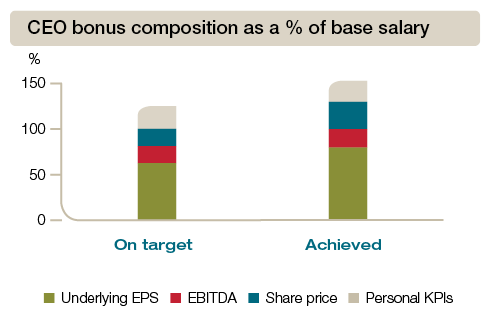
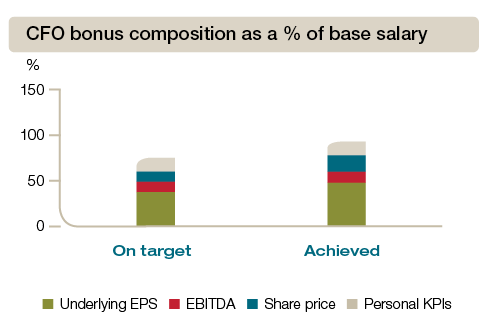
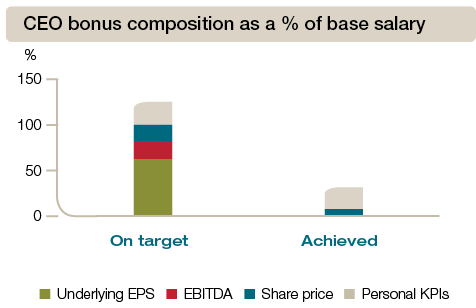
The personal performance element, constituting 20% of the potential bonus, includes several key performance indicators for each executive director which are also aligned to the Group’s overall strategy. At the end of each financial year, the achievement of the corporate financial targets is measured and the achievement of the personal targets is assessed by the Remuneration Committee. The on-target bonus level has been set at 125% of base salary for the CEO and capped at 200%, and 75% of base salary for the CFO and capped at 120%. |
The bonus structure for FY15 remained the same as for FY14. | ||||||
| Long-term incentives: share-based remuneration | Equity-settled share-based incentive schemes for Group employees are in place to encourage and reward superior performance and to align the interests of participants as closely as possible with those of shareholders. These are:
|
See below. | There was no change in the rules of the plans in operation under the terms of the 2012 SARs and LTIP grants; neither scheme vested in May 2015. | ||||||
The Board has set out shareholding guidelines for executive directors whereby a shareholding with market value of twice annual base salary should be built up over the three years from appointment. The share-based remuneration schemes are intended to enable new executive directors to achieve this shareholding guideline and executive directors are not expected to purchase shares in the market if the share-based remuneration schemes do not deliver sufficient shares to meet the guideline shareholdings in the timescale.
Datatec’s subsidiaries operate a number of cash-settled share-based incentive schemes for their senior employees based on the subsidiary’s equity value as determined by annual valuations by independent valuers. Summaries of these schemes are also provided below.
The composition of the annual bonuses of the executive directors for the year under review and for the previous year, shown as a percentage of base salary and split by the bonus elements are shown below:

Datatec Group share-based remuneration
The Board has appointed Simon Morris as the Compliance Officer (as defined by section 97 of the Companies Act) for the Datatec share-based remuneration schemes, to be responsible for their administration.
Datatec established the Datatec Limited Share Incentive Trust 2005 (“the Share Incentive Trust”) to hold Datatec shares, either new issues or purchased in the market, as treasury shares pending their use in settlement of share scheme awards. Settlement of awards which have vested under the share schemes is made by transferring new shares to participants from the Share Incentive Trust.
These schemes are all equity-settled and their earnings dilution effect is included in the diluted EPS figure.Details of these schemes are given in Note 2 to the consolidated annual financial statements.
The Datatec Limited Share Appreciation Rights Scheme 2005 (“SARs Scheme”)
Eligible employees may receive annual grants of Share Appreciation Rights (“SARs”), which are rights to receive shares equal to the value of the difference between the exercise price and the grant price. Eligible employees are executive directors and managers employed in Datatec head office functions. The number of SARs granted is proportional to the base salary of the recipient and awards are approved by the Remuneration Committee. The grant price is the “face value” of a SAR that is taken to be the 30-day volume weighted average Datatec share price on the grant date. In May 2014, recipients were granted SARs with a face value in the range 100% to 150% of their annual base salary.
Vesting of the SARs granted to date is subject to performance conditions. The duration and specific nature of the performance conditions and performance period are stated in the letter of grant. The condition that was imposed for the grants of SARs in 2012 and subsequently, was that underlying EPS (in US cents) must increase by 2% per annum above US consumer price index (“CPI”) inflation over a three-year performance period in order for 50% of the SARs to vest. For the other 50% of the SARs to vest, underlying EPS (in US cents) must increase by 4% per annum above US CPI inflation over a three-year performance period. Between these two limits a sliding scale of vesting between 50% and 100% will operate.
Growth in underlying EPS is seen by the Remuneration Committee as a key measure of achievement of the Group’s long-term strategy, and 2% above US CPI inflation is seen as the minimum growth threshold which must be achieved.
For the May 2011 SARs awards, the underlying EPS of 37.9 US cents was set as the base for the performance condition. The performance condition was first tested in May 2014, when underlying EPS growth to 28 February 2014 was compared with US CPI inflation plus 6% over a three-year period. The result of this test, confirmed by an independent third-party adviser, was that the performance condition had not been met and, accordingly, the 2011 SARs did not vest in May 2014. The May 2011 SARs award was the last to have a retesting provision attached and as a result, was subject to retesting of the performance condition in May 2015, when underlying EPS growth to 28 February 2015 was compared with US CPI inflation plus 8% over a four-year period. The result of this test, confirmed by an independent third-party adviser, was that the performance condition had not been met and, accordingly, the 2011 SARs did not vest in May 2015. The performance condition will be tested again in May 2016 for the final time.
After vesting, the SARs become exercisable. Upon exercise by a participant, the Company will settle the value of the difference between the exercise price and the grant price by delivering shares. SARs not exercised within the period specified in the letter of grant, to date seven years from grant in all cases, will lapse. SARs are not entitled to receive any dividends or capital distributions.
The SARs in issue at 28 February 2015 constitute a 0.12% (FY14: 0.15%) dilution of the Company’s weighted average shares for the year, based on the assumption that new shares will be issued to settle them. The settlement of exercises during the year was made by transferring shares from the Share Incentive Trust.
The Datatec Limited Long-Term Incentive Plan 2005 (“LTIP”)
Eligible employees, being executive directors and managers employed in Datatec head office functions, receive annual grants of conditional awards. The number of conditional awards granted is proportional to the base salary of the recipient and awards are approved by the Remuneration Committee. The face value of a conditional award is taken to be the 30-day volume weighted Datatec share price on the grant date. In May 2014, recipients were granted conditional awards with a face value in the range 67% to 150% of their base salary. The conditional awards will vest after the performance period if and to the extent that the performance conditions have been satisfied.
The duration and specifics of the performance conditions and performance period are stated in the letter of grant. For all grants made to date the performance period has been three years and the performance condition is related to the Company Total Shareholder Return (“TSR”) over a three-year period, relative to the TSR of an international peer group using a common currency basis. The Remuneration Committee considers this to be an appropriate performance condition as it is a direct measure of the Group’s achievement of its strategy to deliver long-term, sustainable, above-average returns to shareholders.
The international peer group for grants of awards under the LTIP which are currently within their performance period at the date of this report is as follows:
| Comparator | ||||
| UNITED STATES | ||||
| 1. | Arrow Electronics, Inc. | USA | NYSE | ARW |
| 2. | Avnet, Inc. | USA | NYSE | AVT |
| 3. | ScanSource, Inc. | USA | NASDAQ | SCSC |
| 4. | Anixter International, Inc. | USA | NYSE | AXE |
| 5. | Tech Data Corporation | USA | NASDAQ | TECD |
| 6. | Ingram Micro | USA | NYSE | IM |
| 7. | Synnex Corporation | USA | NYSE | SNX |
| 8. | Agilysys, Inc. | USA | NASDAQ | AGYS |
| EUROPE | ||||
| 9. | Phoenix IT Group plc | UK | LSE | PNX |
| 10. | Computacenter UK Limited | UK | LSE | CCC |
| 11. | Esprinet S.p.A. | Italy | BIT | PRT |
| 12. | Groupe Steria SCA (Steria) | France | EPA | RIA:FP |
| 13. | Bechtle AG | Germany | XETRA | BC8.GR |
| SOUTH AFRICA | ||||
| 14. | Datacentrix Holdings Limited | RSA | JSE | DCT |
| 15. | Business Connexion Group Limited | RSA | JSE | BCX |
The Remuneration Committee has determined that a larger group of 22 comparator companies will be used for the 2015 LTIP grant in May 2015 to give a better market comparison less susceptible to volatility and inequitable outcomes. The comparator group for the May 2015 LTIP grant is as follows:
| North America | ||||
| 1. | Cgi Group, Inc. | Canada | TSE | GIB/A |
| 2. | Atos Origin | USA | NASDAQ | AEXAF |
| 3. | Avnet, Inc. | USA | NYSE | AVT |
| 4. | Arrow Electronics, Inc. | USA | NYSE | ARW |
| 5. | Ingram Micro | USA | NYSE | IM |
| 6. | Synnex Corporation | USA | NYSE | SNX |
| 7. | Anixter International, Inc. | USA | NYSE | AXE |
| 8. | Tech Data Corporation | USA | NASDAQ | TECD |
| 9. | Agilysys, Inc. | USA | NASDAQ | AGYS |
| 10. | ScanSource, Inc. | USA | NASDAQ | SCSC |
| 11. | ePlus, Inc. | USA | NASDAQ | PLUS |
| LATIN AMERICA | ||||
| 12. | Sonda S.A. | Chile | SSE | SONDA |
| EUROPE | ||||
| 13. | Sopra Steria Group | France | EN Paris | SOP:FP |
| 14. | Bechtle AG | Germany | XETRA | BC8.GR |
| 15. | Computacenter UK Limited | UK | LSE | CCC |
| 16. | Esprinet S.p.A. | Italy | BIT | PRT |
| 17. | Phoenix It Group plc | UK | LSE | PNX |
| SOUTH AFRICA | ||||
| 18. | Datacentrix Holdings Limited | RSA | JSE | DCT |
| ASIA-PACIFIC | ||||
| 19. | Ntt Data Corporation | Japan | TYO | 9613 |
| 20. | Sk C&C Co. Ltd | Korea | KRV | 034730:KS |
| 21. | Redington India Ltd | India | NSE | REDINGTON |
| 22. | Tech Mahindra Limited | India | NSE | TECHM |
The performance condition will determine if, and to what extent, the conditional award will vest. Upon vesting of the conditional award, the Company will procure the delivery of shares to settle the vested portion of the award. The conditional awards which do not vest at the end of the three-year performance period will lapse.
The commitment to issue shares under the LTIP for the conditional awards in existence at 28 February 2015 constitutes a 0.25% (FY14: 0.50%) dilution of the Company’s weighted average shares for the year, based on the assumption that new shares will be issued to settle them.
The TSR, for the purposes of the LTIP, is defined to be the compound annual growth rate (“CAGR”) of the Total Return Index for a company and the peer group as provided by Datastream (a UK-based information provider or any other appropriate service provider as determined by the Company), calculated as follows:
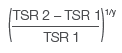
where:
- “Total Return Index” means the index calculated by combining share price performance and the value of reinvested dividends;
- “TSR 1” is the average Total Return Index over each weekday (excluding Saturdays and Sundays) during the 30-day period ending on the weekday immediately before the beginning of the LTIP Performance Period;
- “TSR 2” is the average Total Return Index over each weekday (excluding Saturdays and Sundays) during the 30-day period ending on the final weekday of the LTIP Performance Period;
- “LTIP Performance Period” means the period from 1 March in the year of grant to 28/29 February three years later; and
- “y” is the number of years over which TSR is being measured.
The TSR is calculated on a common currency basis with any non-ZAR values converted into ZAR by reference to the exchange rate on each relevant weekday.
At the end of the performance period the TSR of Datatec is compared with the distribution of the comparator group TSRs over the LTIP performance period:
- If the Datatec TSR lies within the upper quartile of the peer group, the whole LTIP award (100%), which is subject to the TSR condition, will become unconditional and will vest.
- If the Datatec TSR lies at the median TSR of the peer group or lower, none (0%) of the LTIP award will become unconditional and will vest. The remainder of the LTIP award, subject to the TSR condition, will lapse and will be of no further force or effect.
- If the Datatec TSR lies between the median and the upper quartile of the peer group the percentage of the LTIP award, subject to the TSR condition that becomes unconditional and will vest, will be linearly apportioned between 0% at the median and 100% at the upper quartile of the comparator TSR distribution. The remainder of the LTIP award, subject to the TSR condition, will lapse and will be of no further force or effect.
Vesting of the LTIP conditional awards is also subject to the participant remaining in the employ of the Group for the LTIP minimum employment period. Conditional award holders under the LTIP are not entitled to receive any dividends or capital distributions during the vesting period.
The TSR calculation method summarised above was approved by the Remuneration Committee in May 2015. Previously, a different method of calculation for the TSR performance condition was applied (as set out in previous Integrated Reports).
In May 2014, the TSR performance condition for the conditional awards granted under the LTIP in May 2011 (three years previously) was computed (using the previous calculation method) by an independent third party and Datatec was found to rank below the median of the TSR of the international peer group. This meant that 0% of the conditional awards vested and accordingly they lapsed.
In May 2015, the TSR performance condition for the conditional awards granted under the LTIP in May 2012 (three years previously) was computed (again by the previous calculation method) by an independent third party and Datatec was found to rank below the median of the TSR of the international peer group. This meant that 0% of the conditional awards vested and accordingly they lapsed.
The LTIP rules include a requirement for participants to hold some of the Datatec shares they receive on vesting for a period beyond the vesting date. Participants will be able to sell sufficient shares immediately to meet the total tax liability on the vesting but will then have to retain the remaining shares, 50% for one year and 50% for two years, prior to being able to sell them.
The Datatec Limited Deferred Bonus Plan 2005 (“DBP”)
Eligible employees are permitted to use a portion of the after-tax component of their annual bonus to acquire shares (pledged shares). A matching award will be made to the participant after a three-year pledge period, on the condition that the participant remains in the employ of the Company and retains the pledged shares over the period and subject to certain performance conditions. In this context, a matching award means a conditional right to receive shares at no cost to the employee at the end of the three-year pledge period, subject to the employment condition and the performance condition being satisfied. The performance condition in place for the DBP pledged shares purchased in 2012, 2013 and 2014 are such that the number of shares that can be acquired under the matching award is as follows:
- 50% without performance conditions (but with the employment condition)
- A further 50% if EPS increases over the three-year matching period by US CPI +4% per annum giving 100% matching in total
- A further 50% if underlying EPS increases over the three-year matching period by US CPI +8% per annum, giving 150% matching in total.
From the 2015 DBP pledged share purchase onward, the Remuneration Committee has set the performance conditions such that the number of shares that can be acquired under the matching award is as follows:
- 100% without performance conditions (but with the employment condition)
- An additional 50% if underlying EPS increases over the three-year matching period by US CPI +8% per annum, giving 150% matching in total.
For all grants up to and including those in 2011, the vesting of matching awards had not been subject to the satisfaction of performance conditions. Accordingly, the pledged shares purchased under the DBP in May 2011 were matched by an equal number of matching shares in May 2014 transferred from the Trust (ie a 1:1 match).
Currently the employees eligible for the DBP are the executive directors. The participants must use 20% of their annual bonus for a mandatory purchase of pledged shares and may voluntarily use a further 40% of their annual bonus to purchase additional pledged shares. Awards are approved by the Remuneration Committee.
A participant remains the full owner of the pledged shares for the duration of the pledge period and will enjoy all shareholder rights in respect of the pledged shares. Pledged shares can be withdrawn from the pledge at any stage, but the matching award is then forfeited. The shares subject to the matching award are only acquired by the eligible employee at the end of the pledge period and he/she has no shareholder rights in respect of those shares before then.
From the 2012 grant onwards, participants become entitled to receive additional shares on matching, equal in value to the notional accrued dividends or capital distributions arising on the matched shares during the pledge period. The matching shares will not hold any voting rights until vesting.
The main purpose of the matching award is to encourage the employees concerned to acquire and retain shares in the Company through the pledged shares and to retain their services throughout the pledge period. By holding shares in the Company, the interests of employees are also directly aligned with those of shareholders.
The commitment to issue matching shares for the pledged shares held at 28 February 2015 constitutes a 0.11% (FY14: 0.13%) dilution of the Company’s weighted average shares for the year, based on the assumption that new shares will be issued to settle them.
Limits applicable to the SAR Scheme, LTIP and DBP
The aggregate number of shares that may be issued under the SAR Scheme, the LTIP and the DBP is limited to 9 250 000 (approximately 5% of Datatec’s ordinary shares in issue at 10 August 2010). This limit applies to the issue of new shares and not to shares purchased in the market for the purposes of share scheme settlements.
The maximum number of new shares that can be issued to any single participant under the SAR Scheme, the LTIP and the DBP is 4 625 000 (approximately 2.5% of Datatec’s ordinary shares in issue at 10 August 2010).
The face value of the grants made to an employee in any financial year under the SAR Scheme cannot exceed 150% of his/her base salary at the date of the offer. The face value of the grants made to an employee in any financial year under the LTIP cannot exceed 150% of his/her base salary at the date of the offer. The face value of the matching shares in any financial year made under an award to an employee under the DBP cannot exceed 75% of his/her base salary at the date of the offer.
The Datatec Share Option Scheme
Since the implementation of the SAR Scheme, LTIP and DBP on 16 August 2005, no new options have been granted under the Datatec Share Option Scheme. Options previously granted under the Datatec Share Option Scheme had a ten-year life and ran their course in terms of the rules of the scheme. The last outstanding options were exercised during the financial year ended 28 February 2015.
Subsidiary share-based remuneration schemes
Share-based remuneration plans are in operation within Westcon, Logicalis and Consulting Services. These schemes are based on the subsidiaries’ share price, determined by an annual valuation of the subsidiary by an independent third-party adviser (rather than on Datatec’s share price) and are cash-settled (except in the case of Analysys Mason – see below). The annual valuation of the subsidiary is used to mark the liability to the valuation share price and to establish both a grant price for new awards and the exercise price for vested SARs.
Westcon SAR Scheme
The Westcon Group Share Incentive Plan (“the Westcon SAR Scheme”) provides for grants of SARs based on Westcon common shares to employees, directors (including non-executive directors), consultants and other advisers to Westcon.
The Westcon SARs vest in equal instalments over three years from the date of grant, are voluntarily redeemable in cash in equal instalments over three years beginning on the date of each vesting period, and expire on the last redemption date, which is five years from the date of grant.
Details of the operation of the Westcon SAR Scheme, including grants, exercises and lapses of SARs during the year ended 28 February 2015 and the prior year, are included in Note 2 to the consolidated annual financial statements.
Westcon Africa and Middle East (“AME”) SAR schemes
Certain of the entities comprising Datatec’s former Westcon Emerging Markets (“WEMG”) sub-group, which transferred its operations into Westcon’s AME division during the year ended 28 February 2011, operated cash-settled SAR schemes as follows:
- WEMG Share Appreciation Rights Scheme 2009 (“the WEMG SARs Scheme”)
- Westcon SA Share Appreciation Rights Scheme 2006 (“the WSA SARs Scheme”)
- Westcon Africa Share Appreciation Rights Scheme 2009 (“the WA SARs Scheme”)
- Westcon Middle East Share Appreciation Rights Scheme 2006 (“the WME SARs Scheme”).
The WA and WME SARs schemes were transferred to Westcon Group along with the entities that operated them during the year ended 28 February 2011. The WSA SARs Scheme remains operated by Westcon SA (Pty) Ltd under the management control of Westcon, and the WEMG SARs Scheme remains outside Westcon under the direct control of Datatec.
These schemes are all discontinued, with the last grants having been made in July 2012. Details of the operation of the Westcon AME SARs Schemes, including exercises and lapses of SARs during the year ended 28 February 2015 and the prior year as these schemes wind down, are included in Note 2 to the consolidated annual financial statements.
Logicalis and PLLAL SAR Schemes
Under the terms of the Logicalis Share Appreciation Rights Scheme 2005 (“the Logicalis SARs Scheme”), SARs are granted annually to senior managers. Vesting of the SARs is subject to certain earnings performance conditions. Provided that the performance conditions are met, 50% of the SARs vest after 24 months and the remainder after 36 months. All rights lapse if not exercised by the end of the seventh year after grant.
During the year ended 28 February 2010, Logicalis established a separate SAR scheme, the PLLAL SARs Scheme, for its 65% subsidiary PromonLogicalis Latin America Limited. The terms of this scheme are the same as those of the Logicalis SARs Scheme, but the grants are made to key employees of PLLAL and the annual valuations and appreciation rights are based on the equity value of PLLAL.
Details of the operation of the Logicalis and PLLAL SARs schemes, including grants, exercises and lapses during the year ended 28 February 2015 and the prior year, are included in Note 2 to the consolidated annual financial statements.
Consulting Services division share-based remuneration
Analysys Mason Performance Share Scheme
Analysys Mason operates a performance share plan, approved by its board of directors and shareholders, under the terms of which conditional shares are granted to participants. One-third of the conditional shares vest unconditionally after three years if the participant is still an employee and is settled with the same number of Analysys Mason ordinary shares. The vesting of the remaining two-thirds is conditional on an earnings-based performance condition and may be settled in cash or shares.
Analysys Mason Growth Share Plan
During the year ended 28 February 2010, Analysys Mason introduced a Growth Share Plan aimed at allowing employees to participate in the growth of the business if the valuation of the Analysys Mason business increased by a threshold of 10% per annum over the three years following issue. The “B” and “C” classes of growth shares issued in February 2010 and February 2011 have both lapsed since issue. In the financial year ended 29 February 2012, 17 senior managers of the business subscribed for 200 000 “D” shares (constituting 8.1% of Analysys Mason’s share capital) which have vested with effect from 28 February 2014.
Intact SAR Scheme
During the year ended 28 February 2011, Intact initiated a SAR Scheme approved by its board of directors and shareholders. The terms of the scheme are very similar to the Logicalis SARs Scheme outlined above. SARs were granted to senior management in the year ended 28 February 2011, but no grant has been made since and the remaining SARs are unlikely to vest.
Details of the operation of the Consulting Services division schemes, including grants, exercises and lapses during the year ended 28 February 2015 and the prior year, are included in Note 2 of the consolidated annual financial statements.
Non-executive directors’ remuneration
During the year ended 28 February 2015, non-executive directors received fees unchanged from the prior year, as approved by shareholders at the Annual General Meeting on 17 September 2014 as follows:
- Chairman of the Board: US$190 000 total fee inclusive of all committee and subsidiary board work
- Senior non-executive director’s fee: US$70 000
- Non-executive director’s fee: US$60 000
- Chairman of the Audit, Risk and Compliance Committee: US$30 000
- Member of the Audit, Risk and Compliance Committee: US$15 000
- Chairman of the Remuneration Committee: US$15 000
- Chairman of the Social and Ethics Committee: US$10 000
- Member of the Remuneration Committee: US$7 500
- Member of the Nominations Committee: US$5 000
- Trustee of Datatec trusts: US$7 000.
The Remuneration Committee determines the fee structure for non-executive directors, including the Chairman, based on benchmarking studies prepared by external advisers using data from comparable companies. The committee does not consider it necessary to split directors’ fees into a base fee and attendance fee components, as recommended by King III, because of the near 100% attendance record of directors at Board meetings.
For the year ending 28 February 2016, the Remuneration Committee proposes to increase fees for non-executive directors by 4% to the levels shown below and these fees will be presented for approval by shareholders at the Annual General Meeting on 10 September 2015.
- Chairman of the Board: US$197 600 total fee inclusive of all committee and subsidiary board work
- Senior non-executive director’s fee: US$72 800
- Non-executive director’s fee: US$62 400
- Chairman of the Audit, Risk and Compliance Committee: US$31 200
- Member of the Audit, Risk and Compliance Committee: US$15 600
- Chairman of the Social and Ethics Committee: US$10 400
- Chairman of the Remuneration Committee: US$15 600
- Member of the Remuneration Committee: US$7 800
- Member of the Nominations Committee: US$5 200
- Trustee of Datatec trusts: US$7 280.
Non-executive directors are reimbursed for travel costs necessary for attending Board meetings and do not receive any employment benefits.
The terms and conditions of appointment of non-executive directors are available on request from the Company Secretary. Non-executive directors are not eligible to participate in the annual bonus plan or any of the Datatec share incentive schemes. However, John McCartney, as a non-executive director of Westcon, does participate in the Westcon SARs Scheme as described above. The Nominations Committee is satisfied that this does not compromise his independence as a director of Datatec.
External appointments
Subject to the approval of the Board, executive directors are permitted to hold a directorship in one non-Group listed company and to retain the fees payable from this appointment.
Jens Montanana is non-executive Chairman of Corero plc, an AIM-listed software development business.
Directors’ service contracts
In order to properly reflect their spread of responsibilities, executive directors have employment contracts as follows: Jens Montanana has a contract with Datatec International Holdings Limited; Rob Evans has a contract with Logicalis Group Services Limited; and Jurgens Myburgh has contracts with Datatec Limited and Datatec International Holdings Limited. The employment contracts of executive directors are terminable at six months’ notice by either party and contain contractual provisions for payment on termination.
All non-executive directors have letters of appointment with Datatec Limited and/or Datatec International Holdings Limited. Under these contracts, non-executive directors retire in accordance with the Memorandum of Incorporation of the Company, which is at least every three years. Retiring directors may offer themselves for re-election.
Directors’ emoluments
The remuneration, including bonuses and share-based incentive awards, for individual directors who held office during the financial years ended 28 February 2015 and 28 February 2014 is set out in Note 23 to the consolidated annual financial statements.
The Remuneration Committee has approved the executive directors’ emoluments. The emoluments are set out in Note 23 to the consolidated annual financial statements.
Senior management emoluments
The aggregate remuneration of the 16 most senior executives employed by the Group subsidiaries during the financial years ended 28 February 2015 and 28 February 2014 is set out in Note 23 to the consolidated annual financial statements.
The King III Code recommends that the individual remuneration paid to the three most highly paid executives (other than the executive directors) of the Group be disclosed in the Integrated Report. However, the Remuneration Committee has decided not to apply this recommendation as it is not in the interests of the Company to do so, since there could potentially be a negative impact from a competition perspective.
Other than the executive directors whose remuneration is disclosed in Note 23 to the consolidated annual financial statements, Datatec does not have any prescribed officers as defined by the Companies Act and hence no other prescribed officers’ remuneration is disclosed.
Directors’ share interests
The directors who held office at year-end had the following interests in ordinary shares of the Company:
| 28 February 2015 | Direct beneficial | Indirect beneficial | Associates | Total |
| Executive directors | ||||
| JP Montanana | – | 14 900 000 | – | 14 900 000 |
| PJ Myburgh | 49 294 | – | – | 49 294 |
| RP Evans | 29 731 | – | – | 29 731 |
| Non-executive directors | ||||
| SJ Davidson | – | – | – | – |
| O Ighodaro | – | – | – | – |
| JF McCartney | 731 781 | – | – | 731 781 |
| LW Nkuhlu | 305 | – | – | 305 |
| CS Seabrooke | – | – | 200 000 | 200 000 |
| NJ Temple | – | – | – | – |
| 811 111 | 14 900 000 | 200 000 | 15 911 111 | |
Directors’ interests in ordinary shares of the Company shown above are unchanged as at the date of this report.
Directors’ interests in the ordinary shares of the Company at 28 February 2014 were as follows:
| 28 February 2014 | Direct beneficial | Indirect beneficial | Associates | Total |
| Executive directors | ||||
| JP Montanana | – | 15 463 426 | – | 15 463 426 |
| RP Evans | 24 252 | – | – | 24 252 |
| Non-executive directors | ||||
| SJ Davidson | – | – | – | – |
| O Ighodaro | – | – | – | – |
| JF McCartney | 720 000 | – | – | 720 000 |
| LW Nkuhlu | 300 | – | – | 300 |
| CS Seabrooke | – | – | 700 000 | 700 000 |
| NJ Temple | – | – | – | – |
| 744 552 | 15 463 426 | 700 000 | 16 907 978 | |
Directors’ holdings of SARs, LTIP conditional awards and DBP matching shares are shown in Note 23 to the consolidated annual financial statements.
The executive directors’ holdings of Datatec shares pledged in terms of the DBP are included in the tables on this page.
John McCartney’s holding of Westcon SARs, which he was awarded as a non-executive director of Westcon in line with US practice for directors’ fees and awards, is shown in Note 23 to the consolidated annual financial statements. These awards have been ratified by the Datatec Remuneration Committee.