 AR
AR Downloads
 Glossary
 Search


About this report
Datatec is proud to publish its first standalone responsible business report, for FY25, with a view to setting out its environmental, social and governance (“ESG”) principles and approach as well as transparently highlighting its initiatives, performance and plans in each area.
Through its responsible business efforts, which are embedded in Datatec’s overall strategy, it aims to create value for all of its key stakeholders including employees, customers, partners/vendors, investors, communities, and the environment.
This responsible business report is a key communication tool for informing investors and other Datatec stakeholders of Datatec’s commitment to building a sustainable future for its communities, the planet and the Group.
This report is one of a suite of reports produced by Datatec, which also includes the annual report and the integrated report. The integrated report includes comprehensive coverage of the responsible business practices of our divisions, which should be read in conjunction with this report. The divisions also publish individual responsible business reports, available on their websites.
Scope and boundary
This report covers relevant information for the period 1 March 2024 to 28 February 2025 (the FY25 financial year).
The responsible business reporting boundary covers the impact of Datatec’s operations on environmental, social and governance matters, as well as their respective impact on its operations. Non-financial and financial performance data presented in this report relates to Datatec Limited as the reporting entity, which includes all entities that it owns and over which it has control. This aligns with the Group’s financial reporting boundary as relevant for its other reports.
Stakeholder engagement
Datatec aims to create value for all stakeholders in the short, medium and long term. Understanding the needs and expectations of our stakeholders is fundamental to achieving this objective. Datatec has identified seven key stakeholder groups that may impact or be impacted by its business strategy, activities and policies. We rely on these stakeholder groups to create value and our focus is on strengthening our relationships with them, understanding their needs and meeting their expectations
Our shareholders remain a key stakeholder group and Datatec offers shareholders an opportunity to invest in a leading international ICT group that is uniquely positioned to take advantage of best-in-class solutions, while aiming to improve shareholder returns sustainably and responsibly. Our commitment to building relationships with all stakeholders remains at the core of our engagement approach with shareholders. In January 2025, Deepa Sita, Remuneration Committee Chair, and Maya Makanjee, Chair of the Datatec Board held a series of face-to-face shareholder meetings on ESG related matters to ensure an optimal alignment between Datatec and its shareholders.
Our double materiality assessments described later in this section included customer engagement activities. Other notable stakeholder engagement activities undertaken in FY25 included:
- A number of investor meetings during the year which covered ESG topics.
- Employee surveys are used regularly across the Group as one of the ways in which members of our teams are engaged; these generally include evaluation of inclusion and belonging programmes.
- An extensive engagement programme was undertaken with larger suppliers at Westcon International to establish a baseline for sustainability data.
For more information on Datatec’s engagement with stakeholders, refer to the Datatec 2025 integrated report.
Reporting frameworks, standards and guidelines
Datatec’s responsible business practices and disclosures are guided by a range of ESG-related voluntary, legislative and regulatory frameworks:
| Framework | Jurisdiction | ESG pillar | ||
| King IVTM Report on Corporate Governance in South Africa 2016 (“King IV”) | South Africa | Governance | ||
| South African Companies Act 71 of 2008, as amended (“Companies Act”) | South Africa | Governance | ||
| JSE Sustainability Disclosure Guidance | South Africa | Governance | ||
| Broad-Based Black Economic Empowerment (“BBBEE”) Codes of Good Practice | South Africa | Social | ||
| United Nations Global Compact (“UNGC”) | Global | Governance | ||
| European Sustainability Reporting Standards (“ESRS”) under the European Union (“EU’s”) Corporate Sustainability Reporting Directive (“CSRD”) | European Union | Governance | ||
| Science-Based Targets Initiative (“SBTi”) | Global | Environmental | ||
| Greenhouse Gas (“GHG”) Protocol | Global | Environmental | ||
| Climate Disclosure Project (“CDP”) | Global | Environmental | ||
| EcoVadis sustainability assessment | Global | Governance |
Datatec complies with all relevant legislation and mandatory non-financial reporting frameworks as well as a number of voluntary commitments (including UNGC, SBTi, CDP and EcoVadis) which reflect the importance the Company ascribes to ESG principles and performance. It actively monitors advances in sustainability reporting to ensure ongoing compliance and enhance its ESG disclosures where possible.
For Datatec’s Task Force on Climate-related Financial Disclosures (“TCFD”)-aligned non-financial and sustainability information statement (“NFSIS”), see the Datatec Plc annual report and accounts.
Oversight and approval
The Datatec Board holds ultimate oversight of our responsible business approach and ESG performance, ensuring these priorities are fully integrated into Datatec’s Group strategy.
The Social and Ethics Committee (“SEC”) supports the Board through its detailed oversight of: (i) environmental and social initiatives and performance; (ii) compliance with relevant ESG legislation, regulations and policies; and (iii) responsible business reporting. The Audit, Risk and Compliance Committee (“ARCC”) monitors risk management activities at the Group and subsidiary level on an ongoing basis, including ESG risks. Both the SEC and ARCC have responsibility for approval and sign-off of this report.
Materiality approach
Datatec conducted its first comprehensive materiality assessment in FY24 in order to identify the most important ESG issues to our stakeholders (see our integrated report for more detail on the process undertaken).
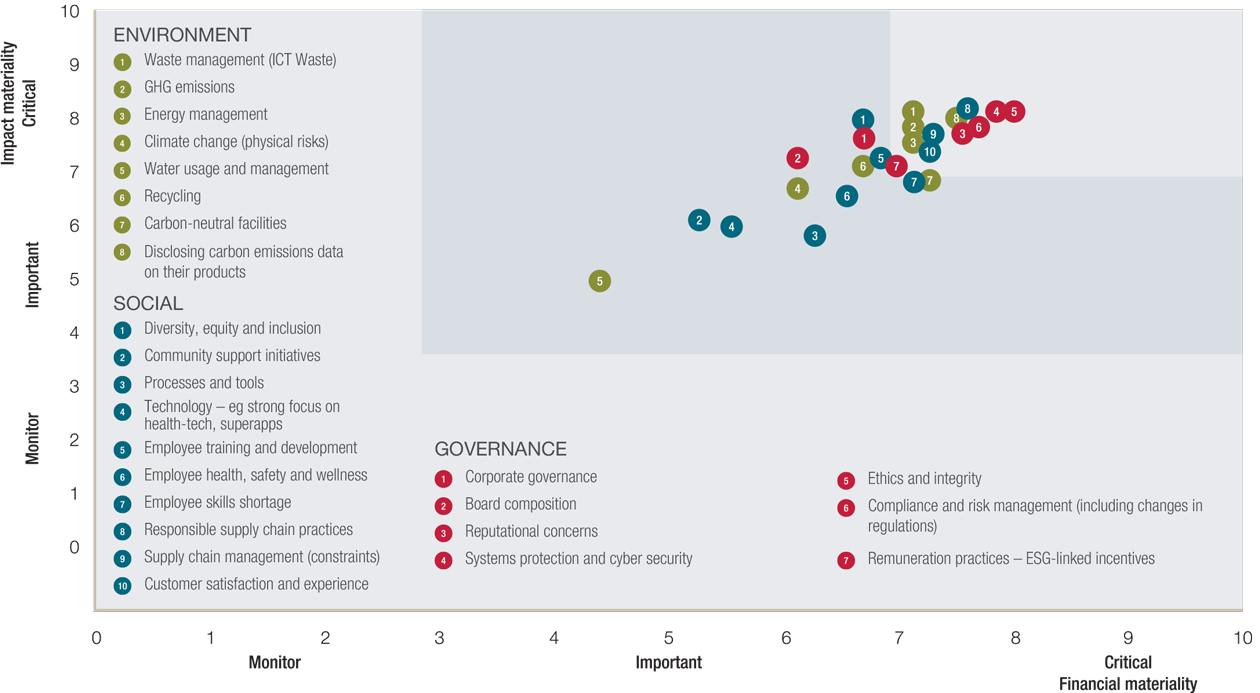
A double materiality approach was adopted, identifying matters that impact Datatec’s ability to create value (financial materiality) as well as its impact on communities, its employees and the environment (impact materiality). Thirteen ESG topics were identified as the highest priority to the Group and its stakeholders, which help guide Datatec’s responsible business strategy and areas of focus. These are set out in the ESG materiality matrix overleaf and summarised below:
Environmental
Disclosing carbon emissions data on products
Carbon-neutral facilities
Waste management (ICT waste)
GHG emissions
Energy management
Social
Responsible supply chain practices
Supply chain management (constraints)
Customer satisfaction and experience
Employee skills shortages
Governance
Systems protection and cyber security
Ethics and integrity
Compliance and risk management
Reputational concerns
In FY25, as part of our preparation for aligning with the European Union (“EU”) Corporate Sustainability Reporting Directive (“CSRD”), two of our three major divisions (Westcon International and Logicalis International) undertook separate double materiality assessments (“DMA”s). Initial findings clearly indicate strong alignment with the FY24 Datatec DMA, reinforcing our confidence in both the rigour of our processes and the relevance of our focus areas across the Group.
More information on these can be found in the integrated report, and the detailed results of these assessments will be set out in each division’s forthcoming responsible business report.
ESG materiality matrix
A full materiality assessment will be conducted every two years as appropriate, to ensure our responsible business strategy remains aligned with stakeholder priorities. As we undertook the divisional DMAs in FY25 as described above, we plan to internally refresh the Datatec materiality assessment in FY26 and undertake another full materiality assessment in FY27.
By continuing to prioritise the issues most critical to our stakeholders across divisions, we can continue to adapt our responsible business strategy to benefit Datatec and our stakeholders.
ESG TOPICS
Further information is available online.
Further information is available within the integrated report.
Further information is available in the annual report.