AR
AR Downloads
 Glossary
 Search


Our communities

Datatec has a long history of strong involvement and investment in the local communities of its companies across the world.
While charitable initiatives across subsidiaries cover a wide range of areas, we actively work mainly towards driving access to education, supporting science, technology, engineering and mathematics (“STEM”) programmes at all levels, and facilitating interventions to increase the number of women and minority groups in the technology industry.
We seek to positively impact the communities in which we operate through four community support interventions: the Datatec Educational and Technology Foundation (the “Foundation”), the Datatec Africa Flagship Project, the Datatec Emergency Fund, and subsidiary community initiatives.
The Foundation
Most prominently we work through the Foundation: recognising that education is the base on which a successful economy is built, it funds educational organisations whose purpose is to improve education within underprivileged communities in South Africa.
Specifically, the Foundation aims to strengthen education of mathematics and science, bridge the digital divide by providing equitable access to technology and educational resources, and empower educators with the tools and knowledge to enhance their proficiency in teaching STEM subjects.
Spend is primarily directed into school-level intervention programmes for learners and teachers, and educational bursaries, while other initiatives include providing technology infrastructure and skills development for unemployed youth. In FY25, the Foundation contributed ZAR10.0 million to education programmes in South Africa.
Beneficiaries in FY25 included:

ProMaths provides after-school and holiday mathematics and physical sciences tuition for Grades 10 – 12 learners in the Eastern Cape’s Mdantsane township.
Offers virtually free university access opportunities to unemployed youth and increase employability after completing their degree courses.
Provides a
blended use of
extracurricular
mathematics
tutoring,
custom-built online
mathematics
programmes
(Grade 7 – 12
learners), and
mathematics clubs
aimed at primary
school learners
(Grades R – 6).
Provides enrichment
education for
disadvantaged
children in
Grades 9 – 12.
Provides integrated academic and psychosocial support to orphaned and vulnerable children.
Is an educational outreach initiative at Hilton College in KwaZulu-Natal, which services more than 100 under‑resourced schools from previously disadvantaged communities.
FY25 OUTCOMES
5 922
(FY24: 3 856)
124
(FY24: 137)
1 337
(FY24: 2 780*)
561
(FY24: 412)
* The Afrika Tikkun organisation, which accounted for many of the FY24 beneficiaries, did not receive support in FY25.
Across all supported projects, there was an increase in the number of students achieving a matric pass from 212 in FY24 to 349 in
FY25. 99.3% of students achieved a matric pass rate, 93.9% a bachelor pass, and there were 89 distinctions in mathematics and
science. Of these, 166 learners are now pursuing STEM-related degrees
in 2025.
Programme highlights for FY25 include:
Through the Foundation, the Olico Diepsloot Centre has been renovated with four new classrooms for the Maths Clubs programme. In addition, the funding has made it possible for Olico to expand the Grade 7 computer lab and installed a container solution at Reshomile Primary School in Diepsloot.
The Kutlwanong Augmented Reality (“AR”) model was successfully integrated into the ProMaths Online platform: teachers and learners are currently interacting with the AR models. The ProMaths AR Experiments project involves creating augmented reality-driven science experiment content for the ProMaths learner platform. Augmented reality will be utilised to highlight granular components such as protons, offering interactive 3D models aligned with the experiment.
The Tomorrow Trust has enhanced their academic testing by assessing the learners quarterly. These assessments are based on higher standards, requiring a passing mark of 50% or above. They are crucial for monitoring academic progress and comparing performance each quarter.FY25 was a successful year for the Foundation, and we look forward to continuing this success through our contributions to well–deserving organisations in coming years.
Foundation case study
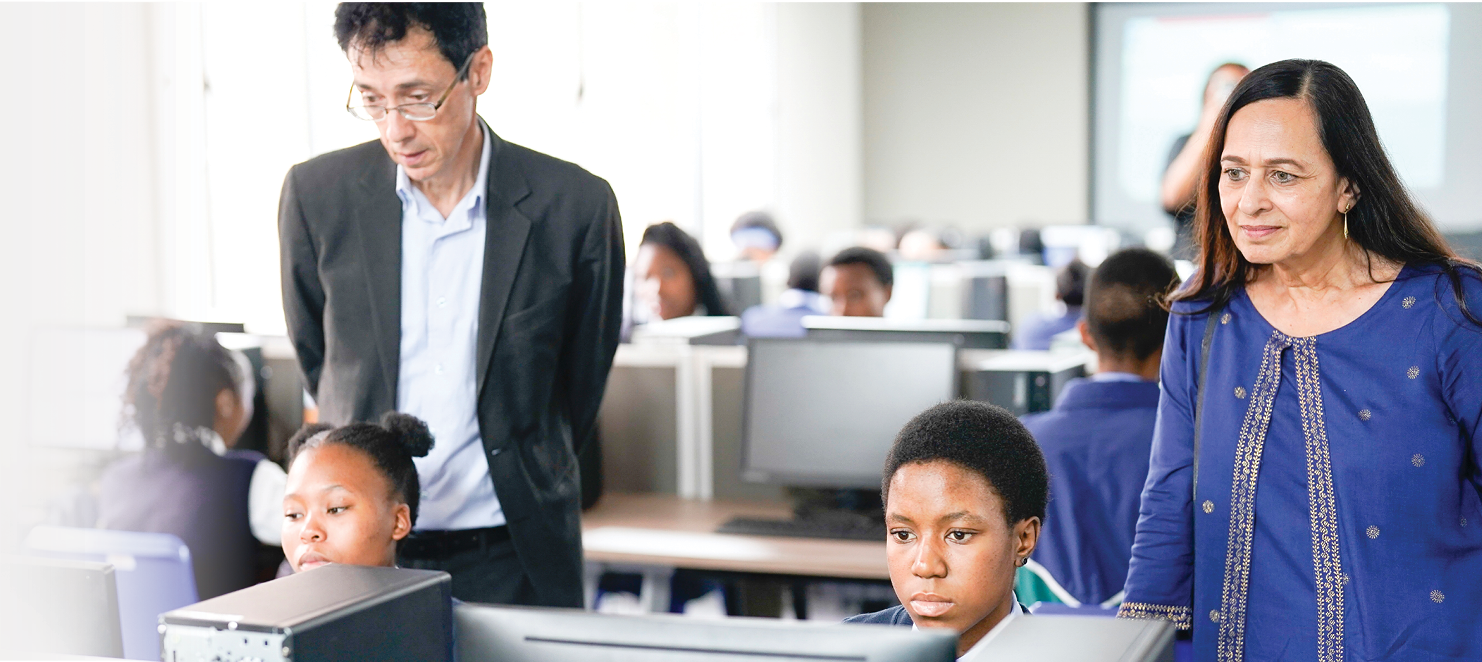
During FY25, the Foundation donated funds to set up three fully equipped computer labs at the Maharishi Invincibility Institute, accommodating 300 additional computer stations in the Johannesburg central business district to help students develop essential technology skills. This has given further impetus to the institute’s drive to ensure that every student, irrespective of background, can access modern technologies and excel in a digital world.
The contribution from the Datatec Educational and Technology Foundation, a long-time supporter of the Institute, will bolster its initiatives, providing bursary loans and educational programmes to help deserving youth further their studies.
Dr. Taddy Blecher, CEO of Maharishi, described the Foundation’s support as a “game-changer,” highlighting its pivotal role as a long-time supporter in the institute’s mission to empower students through education and technology.
“The three computer labs have been set up to boost digital literacy, give students access to online learning tools, and equip them with the tech skills they need to succeed in the job market. Each lab is tailored to support different programmes at the Maharishi Invincibility Institute,” he says.
Blecher believes the new laboratories stand out for several reasons, the most important of which is that they are designed for students with little prior access to technology. Furthermore, they are part of a holistic educational model that combines academics with personal development. Students are also free to use the facilities for research, career development, and entrepreneurship.
“These labs aren’t just about teaching tech skills; they’re about transforming lives.”
Datatec flagship project and emergency response
In FY25, Datatec continued to support the Concern Worldwide “Promoting access to STEM education” project which directly benefited 702 learners and their teachers and reached a further 2 849 learners who participated in the science fair in the Marsabit county of Kenya. Datatec invested US$100 000 in the project in FY25 (and a total of US$150 000 to date), providing mobile laboratories, science kits and training resources for eight primary schools in the county.
There has been strong progress in performance on integrated science exams in 2024, some of which could be attributed to provision of mobile laboratories and integrated kits. A comparative analysis of four project schools shows that there was an increase in performance year-on-year from a 40% average result in 2023, to 61% in 2024.
Datatec has an emergency fund available for donations to help responses to humanitarian
emergencies. In FY25, we donated a total of US$23 650 to crises in
South Africa, Gaza
and Spain.

Education in the community – divisional performance
Datatec supports strategically-aligned community projects at its subsidiaries with funding and resources where required. The priorities of these programmes are focused on three areas: supporting STEM education, increasing diversity in technology, and improving skills in the technology industry.
Across Logicalis International, Logicalis Latin America, and Westcon International, there were a total of 41 education‑focused projects in FY25, benefiting over 1 800 people. Across all community projects (including non-education related initiatives) and charitable donations, over US$400 000 was invested.
FY26 plans
In the coming year, through the Datatec overall community programme we are looking to:
- Continue to develop and scale strategically-aligned community engagement initiatives across the Group, ensuring they deliver meaningful and measurable results
- Use community engagement KPIs to drive further positive impact
- Map localised project impact measures against key projects (for example using a new “Theory of Change” developed at Logicalis International)
Case study:
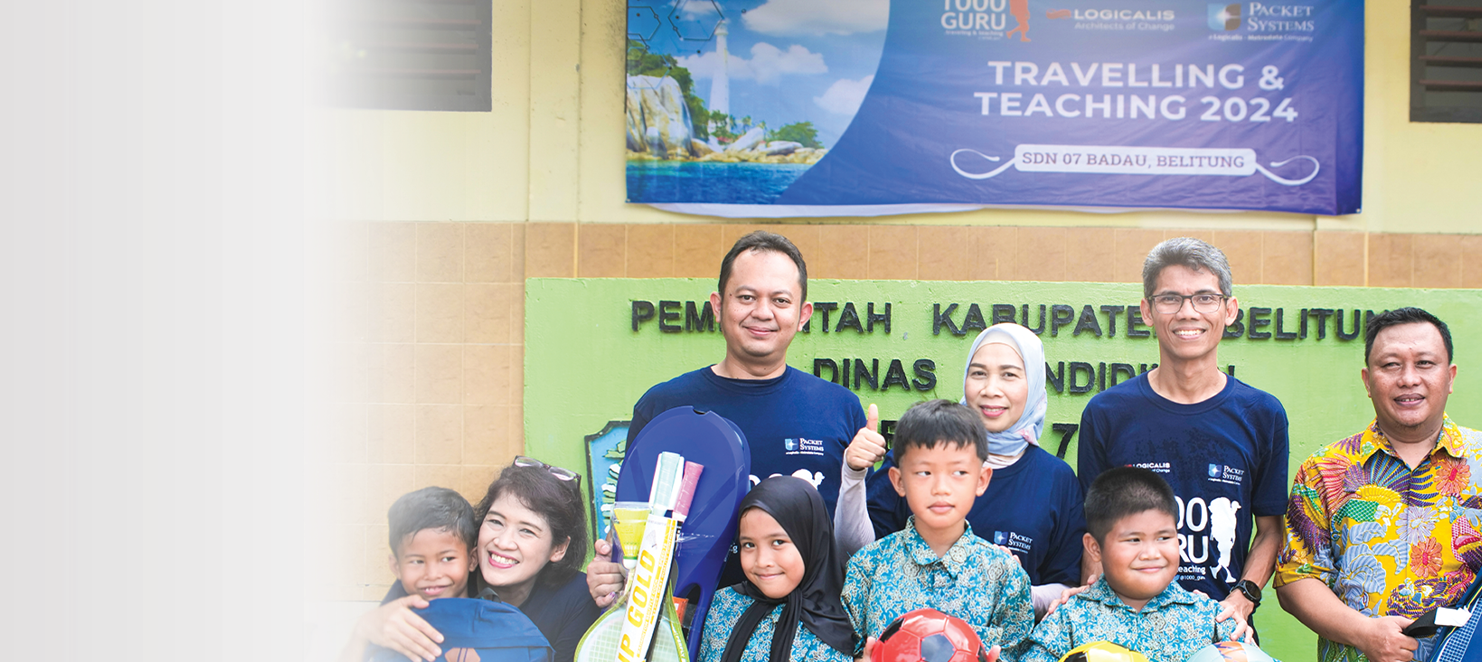
Logicalis International’s business in Indonesia (PSI) partners with the 1000 Guru organisation on its “Travelling and Teaching” programme, a dual-purpose communities initiative which combines community support with employee volunteerism. This initiative provides the best employees at PSI with an immersive experience in Indonesia’s remote areas to promote access to education and empower local communities.
Rural and remote areas are often faced with limited resources and poor ICT infrastructure, hindering digital literacy, educational opportunities and career pathways. The goal of the Travelling and Teaching programme is to help improve this situation and make a meaningful contribution to the lives of young children from low-income families. This is achieved by employees travelling to remote areas and teaching elementary school children about STEM as well as contributing equipment.
In 2024, the third year of the initiative, 26 Logicalis employees travelled to Belitung Island and taught in the underserved
Badau Elementary School, bringing school bags, supplies and sports equipment to support learning. In addition, the trip
included a visit to the Negeri 1 Vocational High school, targeting the
IT-focused departments. With 177 students across the
school (20% of whom are female), the introduction of “Women in Tech” aimed to inspire young female students to pursue
careers in IT. This included an in-person introduction to the technology industry followed by monthly online mentorship
sessions led by Logicalis International’s engineers and consultants.
Through this initiative, Logicalis International provided access to better educational resources and promoted greater gender inclusion in STEM education. As a result, the partner schools have seen an increase in student enthusiasm and engagement. This project reflects Logicalis International’s commitment to empowering communities while investing in people.
Further detail on divisional community efforts can be found in the divisional sections of the integrated report.
The goal of the Travelling and Teaching programme is to help improve education and make a meaningful contribution to the lives of young children from low-income families.